NOTE:
This page includes three essays. The first is about my discovery, in 1987, that I have a kidney disease. The second essay is about being on dialysis years later (from August 2005 thru January 2009). The third essay is about getting a new kidney on January 13, 2009.
(I have separated these three essays about my kidney saga from the other longer MY LIFE STORY page in order to make it easier for people interested in this topic to find these essays.)
SPECIAL NOTE:
There will be a lot more about my inspirational donor Terry in the essay about my transplant. He’s my hero.
Also—a huge acknowledgement and thank you to Judy (my Social Worker at dialysis). Thank you to all the people who put me on the dialysis machine each time–especially Larry, who did it the for the last year or so. Thanks to the doctors who answered all my questions patiently at dialysis, and to Emily and Clara, my fantastic post op Transplant Coordinators. And, of course, to my long time doctor, Dr Falk— and to Dr. Kozlowski, the surgeon who did my transplant. And finally, to all my friends and family who helped me out along the way. It’s dangerous to single people out, but…Erica, Andrew, and Zach were especially helpful. My family was there the most for me—my parents, my brothers, and niece Alison. Their support and assistance will be described in the transplant essay!
WEBSITES ABOUT KIDNEY DISEASE AND RELATED ISSUES:
1) FOR INFORMATION ABOUT ALMOST ANY ISSUE RELATED TO KIDNEY DISEASE, NUTRITION FOR KIDNEY PATIENTS, DIALYSIS, TRANSPLANTS, AND MUCH MORE…GO TO:
2)TO CREATE A PROFILE IN ORDER TO FIND A KIDNEY DONOR, OR TO LOOK AT POTENTIAL RECIPIENT PROFILES IF YOU WANT TO DONATE A KIDNEY…GO TO:
matchingdonors.com
__________________________________________________________________________________________
THE JOURNEY FROM DISEASE DISCOVERY TO GETTING A KIDNEY TRANSPLANT:
THE DAY I SAW RED
In the first several years after graduating from the State University of New York at Oswego, I meandered through various jobs—working as a door to door appointment maker for aluminum siding salesman, a teacher, a counselor, and landscaper. After ultimately not loving any of those jobs, I decided to apply to Graduate School at SUNY Albany in order to get a Masters in History. I was accepted and signed up for the Spring semester to take three History classes and one Architecture class. Truthfully, though I love history, I mainly went back to school to gain a reprieve from the working world, to give me time to iden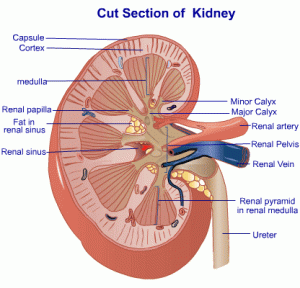 tify a meaningful goal.
A couple of months into the semester, I took a three-hour trip to New York City on a Greyhound bus to see my friends Ellen and Val. I met the two of them while I was in college at Oswego. After meeting Ellen my Sophomore year while living in Seneca dorm, she and I leaned on each other for the next three years. We talked about family, politics, jobs, friendship, love, and how to cope with life in general. We kept each others spirits up when our moods were low and stress was high. The summer after our Junior year we took a five hundred mile bike trip together from Oswego to Sandusky, Ohio. The many days we spent pedaling together solidified our friendship.
I met Val my Senior year when she came to visit Ellen. After only spending a few days together, we both felt like we had already known each other for a long time. We fell into a deep and rewarding friendship. After our initial meeting, we hung out together every time she came to Oswego for a visit.
The three of us didn’t part ways after ending our college careers. We arranged to live together in Albany the summer after Ellen and I left Oswego. At the end of that hazy, lazy, crazy summer Val and Ellen both moved away. I knew all along that they would be moving, but that didn’t make it easier to say goodbye. After they left Albany, we all stayed in regular contact by phone and letter, but we weren’t able to see each other a whole lot. Ellen moved to New York to begin a career in city government and Val went to American University to get her Masters in Business. As always, it was fun when we were able to get together. Easy banter was always in the air when we were around each other.
After Ellen met me at the Port Authority in Manhattan, we hustled to the subway and made our way back to her apartment in Brooklyn. The plan was for Val and I to stay with Ellen and a couple of her housemates for a few days. Brooklyn is, of course, a dynamic place. It was easy to get swept up in the energy of the area. There were lots of cars, people, pizza places, small businesses, tightly packed homes, pavement, and various urban sounds contained within a relatively small space. In Brooklyn’s tightly packed environment you regularly hear people yelling, hear sirens blaring, tires squeaking, and horns blowing. You can see people hawking their various funky items on the streets and smell the foods that are being sold from sidewalk carts–hot dogs, hamburgers, pizza, burritos, ice cream, and fries. Albany is a mid-sized city, with a significant population, but it is much less condensed than Brooklyn. In Brooklyn, I alternated between feeling cozy and feeling pressed on.
We were all enjoying hanging out together. We spent a lot of time walking around the neighborhood and playing tennis on the court in front of Ellen’s apartment building. I remember that we had to sign out the net because it couldn’t be left out where people could steal it. We spent most of the rest of our time drinking, laughing, and making fun of each other, just babbling to one another.
Oddly enough, Ellen’s apartment didn’t have a bathroom. She lived in a very large high-rise building, full of enough people to fill a couple of small towns. I think Ellen and her roommates had exclusive use of a bathroom, but it was located just down the hall from their apartment.
We all got up kind of early Sunday morning. After wolfing down some cereal, we were casually sitting around the apartment gabbing. “I’m going to go to the bathroom,” I announced to everyone gathered in the smallish livingroom.
“Okay, we’ll alert the news media,” Val responded.
As I entered the room, I paid more attention to my surroundings than I usually would in a bathroom, simply because it felt odd to be going to the bathroom in a room that reminded me of a Rest Room in a bus station. I lifted the seat, began to pee, and immediately the water in the toilet bowl turned red.I was shaken, knocked back, not able to believe what I was seeing. The stream of urine was deeply red. It looked like someone had dumped a bucket of blood into the toilet.
I was shaking when I got back to the apartment. “I’m bleeding” was the only thing I was able to choke out.
“What did you say?” someone asked.
I didn’t want to yell out in front of Ellen’s roommates, so I pulled Ellen and Val into the kitchen and explained. In a quivering voice, I said, “When I went to the bathroom, I peed out a ton of blood. What the hell is going on? I’ve got to go see a doctor, or go to the hospital. What the hell…shit…why am I bleeding?”
Val was concerned. Though I know she cared, Ellen was not outwardly concerned. She pissed me off. Because I was in her city, I felt like she needed to suck it up and volunteer info about where there was a clinic I could go to. During the hours after seeing the blood, I wasn’t able to put the episode into perspective. As I sat in Ellen’s apartment after the incident, I felt cornered and stressed. I soon gave up on the idea of going to a clinic; instead, I just wanted to get out of Brooklyn and back to Albany. Rather than getting Ellen to guide me to whatever place might be available on a Sunday, I decided that I needed to get back on my home turf as quickly as possible. I wanted to be in a familiar environment while I was sorting out my bloody problem.
The bus ride back up the thruway was long and gloomy. I was trapped within a circle of bad thoughts, not aware of anything inside or outside the bus. I had no idea why I was bleeding, and I couldn’t get the image of the toilet bowl turning crimson red out of my head. I peed before I got on the bus; and, once again, a steady stream of red poured out of me. After that, I decided I would try not to pee much until I could see a doctor. I didn’t want to see anymore blood that I had to until I found out what the hell was going on.
After getting back to Albany, I was counseled to go see a urologist at The Albany Medical Center. During our initial conversation, the doctor told me he wasn’t sure what was going on and said they’d have to do a few tests. The day after my exam the doctor called me at home. I was surprised to hear from him that quickly. He was speaking slowly, in a very somber tone, which got my attention. He said, “Mr. Handy, you have cysts on your kidneys.” I didn’t respond to his initial exclamation; silence lingered for about five seconds. “You don’t have cancer,” he added. I still didn’t say anything. “You have a disease called Polycystic Kidney Disease.” He said a couple of other things and then told me to make an immediate appointment to come and see him again so he could explain things in more detail. I hung up without hardly saying a word.
After he told me I had a disease, I stopped thinking clearly. My mind raced. I panicked. I was too stunned to ask any rational questions. Because of the dramatic tone of the conversation, I assumed I was dying. He, of course, hadn’t said that. After hanging up, I sat next to the phone frozen, feeling like someone had told me that I was no longer Mike Handy. My parents came to pick me up the next morning and take me to my hometown so I could be with people I knew well. I remember us all going to breakfast at Denny’s that morning. When the waitress asked for my order, I stared at her like she was an alien.
“Do you have any whiskey you could bring me with my pancakes?” I muttered to her. I was numb. The only words I could remember from what the doctor had said were: cysts and disease. As usual, my parents were not verbalizing their emotions. As I nibbled on my pancakes, I could see the tension in their mannerisms and on their faces, but we didn’t talk much. They were obviously concerned, but they didn’t seem to know what to say. I didn’t either. At that point, I was just glad to be with them.
After I went back to the doctor the following Monday, things became clearer. He told me that it was usually 10-20 years from the onset of the first noticeable symptoms (in this case my bleeding) until my kidneys would stop functioning well enough on their own. Over time, the kidneys would get steadily worse. the cysts would constantly multiply until there were so many of them that they would overwhelm my kidneys. The cysts would also cause my kidneys to get gradually larger, until they became quite large. There was no treatment for the disease, no way to get rid of the cysts. I would have to come in every six months to check on how the kidneys were doing. They would regularly check my creatnine level, the best indicator of how well the kidneys were doing their job. He reminded me about dialysis and about transplants. The disease wouldn’t be a death sentence because I could go on dialysis or receive a kidney if things got worse.
“If you must have a kidney disease, this is the one to have,” he told me. “There are possible symptoms you can have, but you can continue on without many symptoms until you get to the point when you need a transplant. Some people even die from something else without getting to the point at which their kidneys stop working.” He explained all of that, and then added, “Some people get hit by a truck and killed, so maybe you’re not so bad off.” My eyes darted back and forth when he said that. It seemed like an odd thing to say. I knew he was just trying to put things in perspective. It was a good thing that doctors are paid for their medical skills, and not for their ability to communicate wisely. Despite that awkward comment, he was a good man. He was patient with me, generous with his time, and straightforward without being cold-hearted.
I learned that the related symptoms can include high blood pressure (which I already had), kidney stones, bleeding in your urine from popped cysts (that’s what happened in Brooklyn), back pain, having to urinate more frequently, and a couple of other less likely symptoms. The disease does, though, move very slowly. It can certainly take longer than the 10-20 year estimate for things to go bad (sometimes much longer). That’s the very good news. The other good news is that people’s kidneys can function well at diminished capacity. It’s often only when you get very near dialysis or a transplant that you exhibit more dramatic symptoms.
It gnawed at me to know there was something out of whack within my body. I felt betrayed. I felt imperfect. I was scared. Being in my twenties, I was really still a little too young to be as calm as I would be a few years later on. For at least a few months after the diagnosis, my diseased kidneys dominated my thoughts. It didn’t matter to me that the rest of my body was functioning smoothly. My damaged kidneys temporarily took over my sense of self. I had become damaged goods–less whole than other people, less vibrant, less confident. For awhile, I think it effected almost everything I did. I realize now that it effected my mood, my relationships, and my searches for employment.
After a lifetime of playing all kinds of sports, I cut back to almost nothing. When I did play, I played haltingly, as if I was physically prevented from moving smoothly and assertively. I remember running around the tennis court like Frankenstein, stiff and lifeless. I remember my brothers laughing at me, and yelling, ” What the heck is wrong with you?” I just stared at them, not knowing what to say. There was no rational reason for me to be moving like a dinosaur. It was purely psychological. (About a year later, I began putting it all in better perspective and realized that the kidney situation was only one part of who I was—and everything else was still okay!)
The other effects were harder to measure. I was depressed, but it was a low-level of sadness. I wasn’t close to being shacked up in my bedroom, but I did lack a spark. I felt like my life had been suddenly cut into segments, possibly shortened, and it left me feeling confused about how to set goals. It cluttered my mind, made me feel less vibrant, and less attractive as a job candidate. I think it made me want to coast along in neutral. I probably also wanted someone to help me take care of myself.
I once went to a workshop that asked the question: WHAT ARE YOU PRETENDING NOT TO KNOW? That would have been a great question for me to ask myself at the time. I wasn’t consciously thinking many of the thoughts I’m articulating now. But they were there, like a hidden layer of frosting on a multi-layered cake. The negative thoughts bounced around, but I wouldn’t allow them to take shape. I wouldn’t say them out loud. I wouldn’t acknowledge them, which probably made things worse.
In the meantime, I had screwed up my grades at school. I kicked ass in the classes I enjoyed, but I flamed out in my Architecture and in Central American History. After finding out about my kidney problem, I lost focus. I was never dedicated to the idea of getting a Masters to begin with. As I mentioned earlier, going back to school was partly an escape from the mundane work-a-day world. Given that fact, it wasn’t surprising that my academic life quickly got off track after the kidney problems arose.
Now, as I was coping with my new medical situation, I was unemployed, poor, and aimless. In order to put food on my table I took a job at a liquor store, working for my college roommate’s Dad, a big round jolly hard-working man. His name was Boleslaus, but everyone called him Boli. Andy (my ex college roommate) also lived in Albany and continued to be one of my best friends. We had been close buddies ever since moving in together in Seneca dorm my sophomore year. His parents, who lived one city over from Albany, had been very good to me ever since I met them while Andy and I were still in school together. Andy asked Boli about me working at the booze factory and Boli quickly paved the way for me to get the job. Given our history with each other, it was no surprise at all that Boli and Andy were helping me out when I needed help.
It was good to be making a little money, and it was exceedingly nice of Boli to give me a job, but I really didn’t enjoy working there. One day, as I was unsuccessfully looking for a particular bottle of wine on the right side of the store, Boli playfully yelled at me, “The liquor is on the right and the wine is all on the left side of the store!” I looked at where he was pointing and realized how ridiculously easy it should have been for me to see what he was pointing out to me. I felt like an idiot when I realized how obvious it was that the store was divided that way. There was nothing for me to say to him, so I just nodded and turned away. I didn’t care about learning new things because the job was so boring, so slow, and so meaningless. It was interesting and challenging work for Mr. Bogdan because he was the manager, but for me it was pure dullness.
A few months after starting to sell booze, I had my first real problem with my kidneys. As I was laying in bed one night, I started having severe pain in my back. I rubbed the spot, rolled around on the bed, and put heat on my back, but nothing helped. I called Dr. Fisher and he told me to check into the hospital. “Get over to the hospital tonight,” he said. “We need to treat you.” The pain did not subside at all in the time it took me to get there. It was a precise, very sharp pain in my lower back, a pain so sharp that it made me moan. They put me on a stretcher and gave me medication. I slept a little, but in the morning I was so nauseous, and I vomited a couple of times, which made me feel even worse. I hadn’t had anything to eat for house. The pain in my back was still there. They finally put me in a room. They told me that there was either a blood clot that was trying to get through a thin passageway, or a kidney stone. It was more likely a kidney stone.
I spent a lot of time laying in bed. Every time the painkillers wore off, I’d buzz the nurse to bring me more.
“What do you need Mr. Handy?” the nurse would calmly ask me.
“I’m in a ton of pain again. I need more stuff.”
They gave me a lot of shots in the hip. Though the whole situation was frustrating, stressful, and very painful, I did enjoy the hazy serene feeling I got right after the injections.
I ended up spending about five days in the hospital. Though doctors and nurse are caring and thoughtful, five days in a hospital can seem like five months. Some nights, just as the pain subsided and I got to sleep, a technician would wake me up for blood draws and blood pressure readings. Then, of course, there is the general poking and prodding and the lack of easy mobility when you’re hooked up to an IV.
They never did find the stones. They kept me under observation for that long only because they wanted to be sure that I didn’t get an infection. After the first couple of days, the pain subsided quite a bit. At some point, the stone either dissolved or popped out without anyone spotting it in my urine. In any case, after a week of lying around, my urine was back to being the correct color, my back was free of pain, and I was headed back home.
The kidney stone episode was the last serious problem (related to PKD) that I had for many years. Very soon after the hospital stay I went on a date with a woman named Jackie, which eventually blossomed into a two-year relationship. As time went by, I thought less and less about the disease. The only physical reminders were the rare times when I had blood in my urine again, which usually meant simply that another cyst had popped.
I went every six months to see Dr. Horn and got my creatnine level checked. It nudged way upward at times, but made no dramatic leaps. I settled into the reality that I had the disease and lived my life as I had before—playing sports, having fun, working, being in relationships and then break ups with women, leading a very normal life. But, there was the awareness that somewhere down the road there could be a problem. The problems turned out to be about fifteen years down the road.
__________________________________________________________
SUCKING MY BLOOD
In 1987, after seeing blood in my urine and going to see the doctor, I found out that I had Polycystic Kidney Disease. My father was diagnosed with the same disease in 1992. At that point, it became clear that the disease ran in our family. In 1994, after living for ten years in Albany, I moved to Chapel Hill, NC.
In 2001, after my younger brother Chris was tested and found to be free of the disease, he had his kidney removed in order to give it to my Dad. Chris was thirty-two at the time. He was married to his sweet wife Alison, and they had a beautiful little baby girl named Ainsley. Chris jumped at the chance to help Dad. To my knowledge, he never had any serious reservations. He saw what needed to be done and enthusiastically did everything that was asked of him.
The transplant was done at The Albany Medical Center, the same hospital where I was originally diagnosed with the disease back in the eighties. Mom, my brother Tim and his wife Janet, and I all made the trek to Albany to support Dad and Chris. We anxiously waited downstairs for about four or five hours to see them, killing time gabbing with each other in the waiting room, mostly talking about Dad and Chris. The first time we saw Dad he was already sitting up in bed making calls. Mom and I laughed because it was so typical of Dad to be on the phone with someone. When I was a kid and Dad was a teacher and Fire Chief, he was constantly on the phone with people talking about work or some other such thing.
My Mom yelled out, “What are you doing Bob. We thought you’d be laying here sleeping or moaning.”
“I wanted to let people know what’s going on.” My Mom and I smiled because it was also typical of Dad to want to keep people informed.
After they left the hospital, Dad and Chris never looked back. Dad has done remarkably well since the transplant. There’s a very challenging prolonged recovery period after the surgery, of course, but he’s had no rejection issues and no other serious issues related to the transplant. He benefited from the fact that the kidney was a very close match coming from Chris, but he also bounced back quickly because he’s strong-willed (a trait passed on from my tenacious stubborn and hard-working Grandfather, who lived to be 93 years-old) and because he’s always wanting to move on with things. Chris was in a lot more pain after the operation because removing a kidney requires a lot more cutting than putting one in, but he recovered completely in about a month.
After Chris got intimately drawn into our kidney saga, it meant that Tim and Mom were the only ones in our immediate family not directly involved. They were obviously, though, very much involved in every aspect of what was going on with me, Dad, and Chris. When anyone goes through a crisis, friends and family become immensely important as a means of support. Our family has always been very proud of the Handy name and fiercely loyal to each other. There was never a doubt about the intensity in which we’d step up for each other in any time of need, whether it be a full-blown crisis or some goofy smaller problem.
I was about four years into a job at UNC Student Stores when Dad had his transplant. Since moving to Chapel Hill, I had worked as Events Coordinator for The Intimate Bookshop, been dumped by a woman after an intense romance, and had seen many friends come and go. Chapel Hill is one of those hot spots in the country that people come to in order to try it out. It’s like tasting a great new ice cream flavor for the first time. The problem is that younger people tend to want to enjoy more flavors, so they move on to Austin, or Ann Arbor, or Portland, or some other trendy location. I had met many cool people in Chapel Hill, but, by the time 2001 rolled around many of them had moved away. In addition to a few good friends my regular companion was my dog Babe, a spirited and loveable Black Lab.
After The Intimate closed down, I got a job working in The Bull’s Head Bookshop at UNC Student Stores. I was content there. I always loved the atmosphere in Chapel Hill, and I especially loved the campus. I eventually was promoted to a supervisory position, supervising a staff of thirty students who worked in customer service. I generally loved the students. I enjoyed their energy, their optimism, their senses of humor, and their tendency to be straight forward. One student in particular became a good friend away from the store. A young woman named Charly touched me in many ways. She had some kidney problems, which was obviously a common experience between us. It wasn’t the kidney stuff, though, that drew us to each other. I like her because she was authentic, smart, charming, and cool. She had a naturalness about her that drew lots of people to her. At a time when most of my friends were far away, it was comforting to have someone like Charly around.
One of the first things I did in Chapel Hill was to hook up with a Nephrologist at UNC hospital. I fortunately ended up with one of the best Nephrologists in the country. Dr. Falk instructed me to do the same thing I had done while living in New York. I began seeing him every six months to continue measuring my kidney function. PKD is slow-moving, but also methodical. The disease sometimes stagnates and often inches along, but it never gets better.
About two and a half years after Dad’s transplant, my creatnine level began to take bigger jumps, nothing too dramatic, but enough to get Dr. Falk’s attention. We started talking about who could potentially be a donor for me. It was still, though, something that was preliminary. The plan all along was for my brother Tim to donate to me, so I could avoid dialysis. When Chris decided to donate to Dad we all talked about Tim giving his kidney to me if it became necessary.
I started to talk to Tim about it again. I called him on the phone and told him what was going on. “Here’s the deal Tim…I’m only talking to you again about donating because it’s possible my kidneys could go bad fairly soon.”
Tim didn’t respond enthusiastically to the idea that he might have to donate soon. He alternated between putting me off for a few days and giving me vague answers. I was disappointed that he had reservations, but I understood. He didn’t want someone messing with his body. He had always been a careful person, always careful about not taking chances with injuries or his health in general. I decided to drop the subject temporarily.
A couple of months later, my creatnine level took a bigger jump. The average person’s level is around .8. My level had hovered around 4.0 for awhile, but now it had jumped to 5.0. I wasn’t feeling much different, just a little tired. Then, over the period of another month or so, my creatnine shot up to 6.0. After it moved from five to six, my doctor told me that we had to get my arm ready for dialysis in case it became necessary to get started on dialysis.
“I’m still going to get a kidney from my brother,” I blurted out. “I don’t want to do dialysis.”
“We’ve got to do it just in case,” he replied calmly. “We’ve got to operate on your arm now to get it ready for dialysis because the site will take six months to mature.”
I had to have a fistula put in my arm. As best I understand it, it involves attaching two veins together in my arm to create what I refer to as a “super vein.” Two needles would go in that vein in order to take the blood out of my body, clean it, and then return it to my body through a second hose. I hated the idea of preparing for dialysis! No matter what else happened, I always wanted to avoid going on the machine. Dr. Falk and I had always planned to bypass it by getting a transplant before I needed dialysis.
It was now time to talk more seriously with Tim about getting himself evaluated and getting on with the process. I gave Tim the phone number to UNC hospital in order to get things started. They needed to know his blood type, weight, age, and a few other incidentals. After a couple of weeks of not hearing anything, I emailed my transplant coordinator to ask her what kind of info had been exchanged. She responded that she hadn’t gotten anything from Tim yet.
I had been delicate with Tim because I didn’t want to push him too fast. There was, of course, some urgency because I needed him to be ready in case things went bad quickly. I called him to see what was going on.
“Hey Tim…How’s it going?”
“Doing good. What’s up?”
“I was just wondering if you’ve had time to send the info to UNC?”
“I’ve got to tell you Mike… I really don’t want to do this.” I stayed silent and digested that nugget of information. “I’m going to do it because it’s you, but I really don’t want to.”
“I understand,” I responded calmly. “I don’t want them to mess with my body either. We’ve both always been protective of our bodies and our space.”
“Yeah, I just hate the idea of being invaded. It makes me feel like I’d have no control over things.”
I was feeling very bad about ever having to ask Tim to get involved, but I needed him. Few things are harder than asking someone, even your brother, to go through major surgery and lose an organ in the process. Eventually, though, without any prodding from me, Tim did get the process started. I was very proud of him for overcoming his fears and starting down a road he wanted to avoid. He made arrangements to be evaluated up in New York. He was forty-three years old and in very good shape. He had always played a lot of sports and was always as skinny as a lightweight wrestler or a jockey. Given his good health, the physical (which is very extensive) would likely be the routine part of the process. I assumed the major issues would be how well our tissue matched (we knew our blood types matched), and whether Tim would get cold feet somewhere along the way. I waited to hear how things were going and soon got an email from Tim saying he’d call me. When he called, he sounded unusually serious.
“There’s a problem Mike. I don’t think I’m going to be able to donate.” I assumed he was exaggerating or had misinterpreted something. I was ready to assure him that he was misunderstanding something.
“They found a couple of cysts on my kidneys,” he continued.
“How’s that possible.” I blurted out. “What does that mean?” Why can’t you donate?”
“They say the cysts are related to PKD. They don’t think I’ll get many more of them, but I can’t help you because my kidneys need to be perfect to be okay for donation.”
My eyes shot from side to side as I tried to comprehend what I was hearing. It was like a tornado had appeared suddenly on a sunny day. Tim had previously been told that he didn’t have PKD; that’s why we had planned on him donating. Now they were telling him he did have some form of it. The good news was that a small amount of cysts would almost certainly never cause a problem for him because he didn’t have lots and lots of cysts the way Dad and I do. The bad news was that they were adamant that he couldn’t donate.
I wanted Tim to say that he was going to fight with the doctor and tell him, “What are you talking about…I’m going to donate to my brother anyway!” It wouldn’t have done any good, but I still wanted him to go down fighting. Tim’s reluctance to go through the surgery had nothing to do with our relationship. We have a life long bond born out of many years sleeping in the same room, playing the same games, and learning the same values. When we got beyond the awkward teenage years, we slowly but surely became great friends. Whatever the reason for Tim’s reservations didn’t really matter because he did try to come through—and I was proud of him for stepping up and starting the evaluation.
It was very hard, though, to digest the fact that he couldn’t help me. I felt like someone who had bet on the wrong horse. For year after year, Tim was the safety net in my mind. My mantra was…if something goes wrong, then I’ll get Tim’s kidney! For about a week, I was emotionally paralyzed. I had never given much thought to other options. I was now stuck. I did remember something that my cousin Pat had said at Christmas time. He told me, “If Tim can’t do it, then me or Jimmy will give you a kidney.”
God, I didn’t want to drag them into this big mess, but I couldn’t think of any alternative. I emailed both of them (and the rest of my cousins—about eight all together) in a mass email to explain what was going on. All of them lived in various parts of the Northeast, mostly in New York. One by one, they all responded they would look into it.
After weeks of exchanging information, it turned out none of them could donate. Some had the wrong blood type, some had medical issues, some just thought better of it because they didn’t want to take the risk while they had a family to support.
I was now truly stuck. I felt isolated. Meantime, my creatnine level was getting worse. Around this time, the doctors insisted that I go ahead and have the fistula operation. Over the past few weeks leading up to the procedure, I had begun feeling more and more tired, especially late in the day.
The operation was a complete success. After the procedure, whenever I had any kind of appointment in which a professional looked at it, they’d say, “Wow, it looks fantastic.” I had no idea what was so good about it, but I took their word for it. I could feel the blood rushing through the site with great power. When people felt my arm they were shocked by the power of the blood flow. They would often pull back, gasp, and giggle. I enjoyed their reactions.
My doctor was thrilled that I had the fistula. “When you get worse, we’ll be ready, ” he exclaimed. He did, of course, share my profound disappointment about not being able to find a donor. I had, by the way, gotten on a waiting list for a cadaver donor (a ghoulish reference, but that’s what they call them) about a year earlier. The problem, though, was that a person of my O blood type had an average wait time of four to six years in North Carolina. Without a donor, I was now pinched into a corner, a corner that contained only one item—a blood sucking dialysis machine.
It was now July 2005. I was going to make my annual trip to my hometown in New York to play in the Gus Macker outdoor basketball tournament. My doctor told me before leaving that dialysis was becoming an immediate possibility. He told me to ingest less potassium and to generally take care of myself. I played with Tim, my cousin Pat, and our friend Joe. Most of our family was around to either watch or to play in another division. We had a great time every year because most of my extended family was around to laugh, cheer, and hang out. The Gus Macker people close down the main street, put up baskets in the middle of the street, and promote it to get people to come and play, or watch, or volunteer to help. I had played in five tourneys and had won a few trophies. The traveling troupe of basketball loving Macker people set up these tournaments all over the country.
The first day I felt pretty good. The second day I felt awful. I could barely walk back to my parent’s house. The last part of the walk is up a hill which runs adjacent to their house. When I pulled my chin up off my chest and looked up the street, it didn’t look like a hill anymore. It looked like Mount Everest. When I finally shuffled into the house, I did something I rarely do…I took a nap. I stumbled up to the guest bedroom, threw myself on the bed, and fell asleep within two minutes.
I had also decided to go on a trip to the state of Washington during the second half of the vacation. It was pretty ambitious, considering that I wasn’t feeling one hundred percent. My good friend Andrew had made all the arrangements, making it much easier for me. He was a teacher and this was his big summer vacation. Andrew and I met while working together at the Bull’s Head. We got to know each other in between shelving books and waiting on customers. After we started playing tennis together (I always exploited his weak second serve, but we were evenly matched), we became really good friends. We have similar senses of humor (observational, quirky, and sarcastic), and similar points of view about all kinds of things.
I knew the trip might be my last hurrah before I got worse, but I wasn’t counting on that as a fact. I was psyched about seeing new territory, about eating a ton of seafood, hanging out at the beach, seeing Mount Ranier, and going white water rafting and whale watching. We had an ambitious schedule, which Andrew had planned out to the last detail. I told him, “Hey dude, you should quit teaching and become a travel advisor.”
Andrew went out ahead of me while I was still in Norwich. After meeting an ex-girlfriend at the Albany airport and spending a nostalgic and pleasant hour with her at lunch, I took off for Seattle to meet up with Andrew. When the plane descended over the city around midnight, there was a spectacular view of the water, the lights, and the sky line. I was impressed because I’m always happy to be around the ocean.
We got up first thing in the morning to drive to the place where we were going hiking. I was tired, but I chalked it up to the time change. The morning after the hike I was exhausted—and remained tired most of the rest of the day. Then something happened that was very weird…I couldn’t eat. We went to a seafood place in a little town on the ocean. I planned on eating a big plate full of scallops, shrimp, clams, and whatever else I could find on the menu. Instead, I couldn’t swallow the food. I was queasy and had no appetite.
“This is crazy Andrew. I would usually eat all this and more. What the hell is wrong with me?” I knew it was probably the built up toxins in my blood, but I couldn’t know for sure. The rest of the trip was the same. I was tired at certain times and I couldn’t eat some other times. It didn’t come close to spoiling the trip, though. I loved seeing the beautiful lakes and rivers, the Pacific coast, the rain forest, and the mountains. We drove all over the state in a smooth riding rental car in just a few days. But, on the other hand, I also knew my body was out of whack.
After we finished the trip and I got back to Chapel Hill, I felt worse. It was hard to walk very far. I was wiped out and still had little appetite. My doctor had told me to come and see him when I got back. I went to see him on a Thursday, two days after getting back.
“You look horrible.” Those were the first words out of my doctor’s mouth.
“I guess I do,” I responded flatly.
“You’re skinny and your skin is gray. You need to get on dialysis now. We need to get you in the hospital and get you started. We can get you in tomorrow and have you stay for a few days.”
“Tomorrow!” I yelped. I was shocked. I didn’t know I’d have to start dialysis in the hospital, and I certainly didn’t think I’d need to start so soon. “I can’t go in tomorrow. It’s too soon. I need more time to get ready.”
“Okay, then you’ll go in on Monday.”
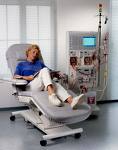
A Person On Dialysis Machine
The only medical issue to clear up before I entered the hospital was to see if my labs matched my symptoms…they did. My creatnine level was through the roof at over 8.0. My potassium and phosphorous levels were also high. It was no wonder I was dragging around like a baby slug. As Dr. Falk had already figured out, everything indicated it was time for dialysis to do the work my kidneys couldn’t do anymore. Without help, I would rapidly turn into an exhausted, malnourished, skinny person. Dialysis would keep me alive and healthy until a kidney became available.
As I walked back to work across campus after leaving the doctor’s office, I looked up at the sun and acknowledged the contrast between the bright warm glow and the dark news I had just received. I closed my eyes and tilted my head back, letting the sun warm me up. I thought about the fact that the thing I had dreaded all these years had finally arrived. I felt sorry for myself for several seconds…and then, after a few more steps, I caved in further and let myself cry. I stood still and allowed myself to shut down and let the new developments sink in without analyzing them. I didn’t, however, linger over the sad thoughts for long…I couldn’t. I knew I had to get organized quickly and make the best of things. I told everyone what was going on…my parents, my boss, my brothers, and some of my friends. I told Andrew that I might need some help from him when I got out of the hospital. I cleaned the excess crap out of my apartment (with Andrew’s help), paid some bills, and generally tried to get my shit together. I decided that I didn’t need the extra stress that would be there if I didn’t smooth out the rest of my life as best I could. My parents called to say they were going to drive down from New York to spend a few days with me while I was in the hospital.
I spent the first eight hours on Tuesday sitting in the waiting room of the hospital. They didn’t have a bed for me yet! It made me wonder whether things were absurdly disorganized (in terms of room availability), or whether the hospital was simply dealing with the uncertainty that exists when trying to predict when patients will be released. In either case, it was frustrating to sit there for that long with nothing to do but stare ahead and think. When they finally got a room ready, my parents had arrived. As soon as I walked in my room, I felt a sense of dread. I wasn’t because I was afraid of anything, or concerned about pain; it was, rather, because I was feeling the sense of isolation in the hospital…and I was remembering the tedious routine. I felt slightly depressed, knowing things were about to be out of my direct control.
They told me I had to have chest x-ray that night and start dialysis the next morning, on Wednesday. In the meantime, there was a lot of waiting, a lot of listening to my roommate whine about his low-level pain. I had empathy for him (he had cut his leg), but he was driving me and the nurses a little crazy because he was complaining about a whole bunch of things. The young guy finally said, “Damn it, I’ll go to another hospital so I can get the pills I want!” My perception was that the hospital was doing all the right things, and he was a serial complainer, who majored in drama.
Chairs Lined Up in A Unit (Minus the Usual Buzz of Activity)
The next morning was case of hurry up and wait. They told me I would go in for dialysis at 10:00am, then they said 11:00, and then they said I wouldn’t be able to go at all that day. They said there was a problem with the equipment in the room. They said the entire room had NEVER been shut down like this before. I wanted to get it over with because I was sick of being in the bed.
An hour later, they surprised me and told me that the problem was fixed and I’d go in for treatment in an hour! I called my parents to tell them about the change in plan.
I started dialysis eight days after my birthday, on August 24, 2006. I was wheeled into a dialysis unit that was filled with much older patients (because people are only on dialysis in the hospital if they are a beginner like me, or if they need the extra care that older folks sometimes need). Most of the patients were either sleeping, staring straight ahead, or moaning. They were all hooked up to the machines via needles and hoses. The nurse told me they would talk me through everything so there would be no surprises. She added, “You’ll only be on the machine an hour today because it’s your first time.”
On a practical level, the scariest thing was the needles. They also explained that my blood pressure would probably go down, that I might get woozy, and my body might react in other ways too. The idea was to pull a certain amount of blood out through one hose, cleanse it, and then return it to my body through a second hose. That meant I had to be “stuck” twice with two different needles.
I sat in a reclining chair next to the machine. They pushed the chair back so I was in a horizontal position. There were about ten machines in the room—loud piercing alarms sounds constantly came out of them. The alarms sounded to alert the nurses that some adjustment needed to be made.
“It’s time to start now,” the nurse told me. Like many people, I don’t like needles—and they were big needles. I couldn’t stop wondering what it would feel like to get the needles put in. I figured it would probably be worse in the beginning because my arm wouldn’t be used to it. When she stuck the first needle in my upper arm, it hurt a lot. I cringed and my body froze. She then stuck in the second needle, which hurt just as much. My arm never completely stopped hurting for the hour I was on the machine. I tried to watch TV, but I mostly just worried about how well I’d adapt to doing this all the time. The nurse, who was very nice, regularly came over and asked how I was doing. “Okay,” I mumbled in response . I was relieved when she came over to tell me that it was time to get off. When she pulled out the needles, she put pressure on the site until the blood clotted, preventing it from squirting out of my arm. “Eventually you’ll have to hold the bandages yourself,” she said.
At that point, after finishing my first go around, I knew I had started down a path that was going to be a challenge.
After the second treatment the next day, I began to have a minor identity crisis. I was very anxious. The treatments made me light-headed, gave me a slight headache, and were making my heart beat very fast, too fast. Some of it was the machine, and some of it was stress. My arm had turned black and blue, either because of a “bad stick” or simply because my arm wasn’t used to the invasion. It looked ugly and freakish, the discoloration extending in a wide area, from the needle site half way down my forearm. I needed to get back to work, back to doing anything normal. I needed to be forcefully reminded that my whole life wasn’t going to involve needles, older people, machines, pain, blood, bandages, the smell of rubbing alcohol, the sound of machine alarms, and questions about my health.
I was in a temporary emotional crisis. We had to go to the dialysis center to talk with a social worker and set up my regular treatments at their facility. I looked like crap. My heart was still in overdrive. I was very tired because of lack of sleep at the hospital. I was still woozy and light-headed. My mouth was dry because of all the fluid that had been drained out of my body. All the talk from the social worker about Medicare and the heavy cost of dialysis was just one more piece of added stress (Medicare, thankfully, does cover the vast majority of it).
After we set up my first treatment for the next morning and left the building, I started babbling, “I’ve got to see my dog! I need to get back to work! I need to do anything normal!” I just kept repeating the same things over and over again.
As we lingered in the parking lot, just standing there, my Dad said, “Let us know…is it a well run place?” I looked at him like I couldn’t understand what he was asking. At that point, on the first day, I couldn’t have cared less whether it was well run or not.
“I don’t know Dad. I wasn’t really thinking about the running of the place. I just wanted to get the needles in and then get them out without me feeling much. I basically just wanted to get out of there.”
“Your Mom and I just wanted to know you’re in good hands here,” he responded.
It was very comforting to have my parents with me, but in some ways they made things seem abnormal too. They weren’t often in Chapel Hill. I didn’t usually sleep in a hotel room with them. I needed normalcy! Later that day, I went to work for about an hour. I wasn’t feeling good enough to talk coherently, so I probably made little sense to anyone. The fall semester was beginning in three days, so I had been right in the middle of hiring people and ensuring that the schedule was set correctly. Consequently, I wanted to get back to work regularly very soon.
I was set up to go in at 6:00am the next day for my treatment. I barely slept that night. I was afraid I’d oversleep. I was going to go in at 6:00 every time, so that I could then have a large chunk of time left to work for the rest of the day. I was afraid, though, that 6:00 was just too early for a night owl like me. I was afraid I couldn’t handle the logistics of all this, that I couldn’t get to the treatments on time consistently and also go to work at the store. I was also afraid that people would see me differently.
I did get to the treatment on time the next morning. I noticed immediately that the other patients were generally just as old as the patients at the hospital had been. That wasn’t comforting. There was one guy younger than me, but the rest of them looked to be over sixty-five, some of them way over that age. The technician was very good with the needles that day, but it still hurt. I did, however, cruise through that day without incident, quietly going through the motions. I was just glad to get it over with.
As the days went by during the first week or so, I subsequently had blood squirt out onto my chair because one of the needles came out too soon (as they were removing it). I had blood accidentally leak out from the needle site. And, one day they had to take a needle back out after several minutes and then put it back in. The day reinserted the needle was my worst day. There’s a lot of technical crap that’s hard to explain, but the bottom line is that the blood wasn’t coming out with sufficient force. The nurses gathered around me and whispered about it. They tried moving the needle around without taking it out, but that didn’t do any good. They finally had to take the needle out. My arm wasn’t used to the beating so I knew it was going to hurt when they put the stupid needle back in. My biggest fear was that it might be a chronic problem. Maybe my arm wasn’t ready to be used this way? (After awhile, I realized hat the first few days were NOT the way things normally went. Over time, as my arm mind and body got used to things, I found that most days were as routine as they could be on dialysis. Most days were the same as every other day—pretty mundane and usually pain-free.)
When they did put the needle back in that day, it did hurt. My arm actually hurt the whole time I was in the chair. It was a stinging, throbbing pain. As I lay there trapped, feeling the pain, surrounded by strangers, I felt like crying.
My regular schedule was to go to dialysis on Tuesdays, Thursdays, and Saturdays. On dialysis days, I got up at 5:00 and began stumbling around in the dark to get to the bathroom door. I’d then let Babe out so she could pee and so I could feed her. It was pitch black out as I drove through the deserted streets on the three-mile trip to the facility. It was tempting to drive right through the red lights. When I got to the turn off for the center, I often fantasized about driving on by and skipping dialysis.
The entrance door to the place was always hard to open. The front waiting room would usually be full of patients waiting to be let into the machine room. The big wooden door to that room had a combination lock on it and a very tiny window to peer through. The people in the waiting room at 5:45am were often sitting there looking like the living dead—slumped over, dazed and quiet, with blank expressions on their faces. Some of them wore the same clothes every day. They usually only talked if the nurses were late letting them in the room. When they did talk, it was all stupid griping about how they weren’t treated well. The truth was that they we were generally treated very well.
The first thing I did after getting into the big room was to take all the stuff out of my pockets and weigh myself. They need to consistently keep track of your fluid intake and output. I’d then go over to my chair (usually the same chair every day) and get my standing blood pressure taken. After sitting down, they’d ask me if I was doing okay and check to see if all the equipment was ready—tape, guaze, hoses, needles, sterile paper. They also always listened to my chest carefully to ensure that there was no fluid build up. Then it was time to stick in the needles. They looked for the right spot, lined them up, and carefully stuck them in. The key was to get them in exactly right so that the blood would start flowing properly. If they were off a little, they’d have to start over. I never relaxed until the needles were in. Once they were in, it was just a matter of lying there for 3-4 hours (different times for each patient–usually 4 hours) while the machine cleaned out your blood. I hated lying there passively while the nurses did everything. I hated the sterility of the room. I hated being separated from the outside world by the thick wooden door. I hated the repetitiveness of the routine. The constant sameness wasn’t good for the soul.
Many of the other patients were much sicker than I was. Other than the kidney mess, I was in good shape. I told people that I felt like Hercules compared to most of the other patients. Some of them came in on stretchers or slumped over in wheel chairs. One lady always came in looking barely alive. I often looked at her and wished there was something I could do to help her. I think our patients were generally worse off than the people at some other centers because the facility is closely connected to the hospital, meaning that we’d get some people who were acutely ill.
About halfway through my treatment one day, a nurse in another part of the room started yelling for help. When the head nurse got to the scene, he said, “Call 911.” I couldn’t see what was happening because it was behind my chair, but I could hear them saying that she had pulled the needles out of her arm. Blood was pouring out on to the floor. I was afraid she might die before the paramedics got there.
In reality, she didn’t come close to dying. They stopped the bleeding before too much had escaped. I don’t know if she was trying to hurt herself or was simply confused. Either way, she wasn’t in a healthy state of mind.
I haven’t had a glorious history with cars. I’ve gone very long stretches of time without having one. I didn’t, for instance, have a car for the first five years I lived in Albany, N.Y. I also didn’t have a car for the first five years I lived in Chapel Hill. When I did have cars, they were old and ugly. (I love public transportation, so being without a car wasn’t something I particularly suffered through.) After I had walked and biked and taken the bus around Chapel Hill for five years, my friend Val and her husband George generously sold me a car that had been in George’s family for a long time. They sold me a white Buick Regal, with about 110,000 miles on it. Actually, they essentially gave it to me. I didn’t give them much money for it because they basically insisted I take it as a gift.
It was great to have a car because it made it easier to get Babe to the park and easier to do errands. At the point when I eventually started dialysis, the car had about 150,000 miles on it. The engine seemed to be in good shape, but I still worried about the life of the car. One weekday morning, after I had started dialysis, I shuffled out to the car in the dark to make one of my trips to the blood sucking center. I got in the car, put in the key, and placed my foot down near the gas pedal. Something was wrong. I couldn’t even find the gas pedal. I couldn’t see anything in the dark, but when I blindly reached down with my hands it felt like there was a maze of spaghetti like crap under the dashboard. When I pulled my hand back it was black and smelly. I couldn’t imagine what had happened. I assumed that someone had vandalized the car. I ran back in the house and found as flashlight so I could see exactly what was going on. I discovered that the area under the steering wheel was all charred and generally ruined. Wires were dangling and everything was black, making for a big fat mess. I called the police because I was still assuming that someone had gotten in the car and damaged it on purpose. The police called the fire department. After they looked at it, they quickly realized the obvious truth. They were sure there had been an electrical short that caused a fire, which fortunately flamed out by itself sometime after I left the car parked the previous evening. It was totally impractical to even look into getting it repaired because of the age of the car and because so much had been burned to a crisp.
The death of the Buick created a big problem. As I thought about the near future, I was panicked because I obviously needed to get to dialysis early each morning. How the heck was I going to get there? The buses didn’t start running soon enough to get me there on time. Even if they did, I would have to switch buses half way there because the center is a mile out-of-town. I found out, though, after doing some inquiring, that there was a special city bus that picks people up near their house and takes them to dialysis or the hospital—so I made arrangements for them to pick me up. They couldn’t get me there until 6:30, but that would have to be good enough. There was, however, one bigger logistical hurdle left. The bus didn’t run on weekends, so I would have to get a friend to give me rides on Saturdays. Who was going to be able to do that every week at 5:30 on a Saturday morning? I’d just have to make that work.
The down side of the bus experience was waiting outside in the pitch black on those very cold mornings (the bus tended to arrive at different times, though it wasn’t supposed to). It was great that I could ride the bus, but it just seemed like a further loss of my independence. The small vehicle also perpetuated the idea that I was now a special case. The regular buses were well-lit and full of people., but my small bus was dark and only contained one other rider, an older lady who seemed slightly incoherent.
I decided to wait three months and try to save money until I went to Norwich for Christmas. I would then buy a car at my parents long time car dealer. It was a patient and practical plan. When I got to Norwich it all went remarkably smoothly. I quickly found a car and borrowed the money from a Credit Union I was able to join because my parents were members. I bought a 2003 Pontiac Sunfire, with only 14,00 miles on it. The sporty car made me feel more vibrant and less stuck in neutral.
The good news, in terms of being hooked up to the machine regularly, was that I settled into a routine pretty quickly. The black and blue marks on my arm went away after about two weeks. The negative incidents with the needles I described earlier didn’t repeat themselves. My appetite came back in a big way. I went back to work at Student Stores almost right away and got things back in order there. As always, I had a very good time working with the students, joking around with them, and just generally enjoying them while I worked with them on their schedules, customer service issues, and all the rest of the stuff that went on at our very busy store. Just to create some separation at work, I tried not to talk too much about dialysis, other than just briefly answering questions about how it had gone on any particular day. The other thing that helped smooth things out was the fact that the nurses were great. (Larry in particular—because he was the one who stuck me regularly.) The nurses were all a little washed out by their crazy schedules and the challenging routine, but they did their best to make it all go as well as it could go. Larry was a smooth operator, confident, laid back, and cool to talk with. He always made me feel comfortable with what was going on. My social worker, Judy, was phenomenal in terms of helping me with paperwork, setting me up with places to be dialysized on vacation, and helping with anything else I needed help with.
In the months just prior to dialysis, I had some bad luck incidents that may have occurred because I was feeling less focused and tough-minded than usual. I fell on the ice one morning and dislocated my pinky finger, pulled a hamstring playing softball, and hurt my ribs on the Scrambler ride at the State Fair. About four months into dialysis, I had to have an operation to repair a hernia. They were all very minor things, but the timing was bad.
Overall, though, things went as well as they could have expected. Nothing went horribly wrong. Other than the weird needle sticks, there is nothing painful about dialysis. It’s still tough, though, primarily because you don’t know how long you have to continue it. It can be many years until you find a donor. It’s the waiting and waiting and waiting that is so frustrating. (Some people aren’t even able to look for a donor because of their age or their overall health—so I was lucky in that regard.)
It is, of course, tough in other ways too. On the days when they took a lot of fluid off, I felt crappy because my blood pressure went low and I got dehydrated. And, If your blood pressure really plummets while you’re in the chair, you can almost pass out until they give you extra saline. Extra fluid off days also can make your ears ring and make you feel woozy and tired. Mostly, though, as I’ve alluded to, the strain came from never getting a break from the three-day a week visits. It was particularly hard to not even get a break on vacations when I had to find a center to go to near where I was staying.
If you’re reading this and you have PKD or some other kidney disease, don’t be too discouraged about the possibility of dialysis. Everyone is different. For one thing, lots of people don’t get sick enough to need dialysis.—and others may be able to do it at home. The other thing, of course, is that people can avoid dialysis by getting a kidney from a friend or relative. I thought I was going to be able to do that!
If you do need dialysis, it’s still different for everyone. The length of time you need it, the place where you have it done, your job status, your family support, your personality, and your general health are all factors that can make a difference. When my father went through dialysis for about a year prior to his transplant, it seemed to almost be a breeze for him.
The bottom line was that I was going to make the best of my remaining years on dialysis, until I could either get a kidney from the waiting list or somehow find a living donor after trying to find one for such a long time. I also decided that once I did get a transplant, I would do anything I could to help streamline the search process and help other people find a donor without feeling like they were largely on their own.
In my case, I knew I was eventually going to get a kidney and get off dialysis. It was just a matter of remaining focused and not letting my frustration run me. In the meantime, I’d just keep chugging along, waiting for the happy day when I’d receive a healthy kidney from some generous soul.
_____________________________
FINALLY GETTING A TRANSPLANT
(I WILL BE ADDING TO THIS STORY REGULARLY. I’M GOING TO DO THE ORIGINAL WRITING HERE WITHOUT HAVING EDITED FIRST.)
As I entered the third year of dialysis, I was getting more and more frustrated with the wait. For the most part, being on the waiting list is a very passive situation . It’s all about WAITING, and I was obviously sick of simply waiting and waiting and waiting. I was dying to do more than shuffle back and forth to the dialysis center. I wanted to finally find a donor and move on with getting a new kidney.
TO BE CONTINUED!!!!!
 :
:  :
:  :
:  :
:  :
:  :
:  :
:  :
:  :
:  :
:  :
: 
 The World According to Mike
Leave a comment