PART I: THE EARLY YEARS
MY HOMETOWN

My hometown
My hometown is Norwich, N.Y. It’s nestled in the Chenango valley in the middle of New York State, about fifty miles away from the nearest large city. It sometimes feels like the town exists under a giant bell jar, protecting it from excessive noise, crime, and filth. When you stand in the middle of Norwich and take the time to gaze at the surrounding hills, you see the way they envelop the homes, the streets, the businesses and the inhabitants. If you let your imagination run a little wild, you might come to the conclusion that the hills provide a protective womb-like environment for our little town to exist in.
The town is fresh and good-natured. It’s small, but big enough (7,500 people) so that it isn’t unsophisticated. The park in the middle of town contains an old style circular band stand, magnificent oak trees, and a majestic two-hundred year old court-house. A photo of the park would fit perfectly on the cover of a picturesque calendar featuring charming small towns.
When I was a kid, Norwich had several large companies located in and around town, which meant that there were a fair amount of white-collar jobs. Consequently, there were many large old beautiful homes of various colors and shapes along the tree-lined main street. Most of them had spacious front porches where family members and neighbors could lounge on a porch swing or a chair and chat. It was also a fine place to enjoy a soothing cold beverage in the summer and a snort of hot chocolate in the winter.
Mostly, though, Norwich was populated by solid old middle class homes filled with teachers and plumbers and mechanics and kids who just wanted to eat Mom’s good cooking, ride their beloved bicycles, play their games, run around and explore every corner of their neighborhood, and get through another year of school.
Since my childhood days, the downtown area has been hurt economically because of the departure of most of the large companies that used to reside in Norwich. We lost a big pharmaceutical producer, the corporate headquarters for a large grocery store chain, and a shoe factory and textile mill. This kind of mass exodus has happened in many Upstate New York towns since the beginning of the 1990s. The economic downturn has had an effect on people’s pocketbooks, but it has not affected the basic beauty and charm of the town.
About fifteen years ago, right after the loss of many of the big companies, Norwich snatched up the New York State High School Basketball championship. A Sports Illustrated writer, who had lived in Norwich briefly, wrote an article for the magazine about our town after we won the championship a second time consecutively. He compared Norwich to Bedford Falls–the town in the Jimmy Stewart movie, “It’s a Wonderful Life.” The story he wrote was dripping with the sense that the writer, who now lives in New York City, has never gotten Norwich out from under his skin. He talked about driving up in a rental car to do the story and being greeted by waves of nostalgia as he wound through the curvy country roads. He talked about how everyone seemed to know each other in Norwich. He talked about the many athletes and characters he met in the various community sports leagues. He talked about meeting the grandkids of people who had grown up in Norwich a very long time ago. He talked about the park and the other hangouts around town. He wrote about the delicious taste of Nina’s thick and chewy pizza, the grungy but inviting nature of a downtown bar called The Grill, the old school charm of the ancient Blue Bird restaurant, the way the YMCA was always full of enthusiastic weekend athletes, and the thrill rides that came to the Chenango County Fair every August. He talked about how enthusiastic and animated people were–shouting, laughing, gesturing when they told him stories about great high school athletes who had played in Norwich in the past.
As I think about it, I realize Norwich is infected with pride. When we spanked every team we played and won the state championship, the 5,000 seat arena in Glens Falls was awash in a sea of purple– the school colors. It’s true that lots of towns brag about themselves and their heritage. For instance, hometown pride is dramatically evident in the classic basketball movie, “Hoosiers”. The people of Norwich aren’t ignorant or self-absorbed. We know we’re not the only nice small town in the world. It’s just that when you grow up in such a folksy environment, it begins to feel like your little town must be the nicest place around. A fondness for the place gradually seeps into your consciousness. Norwich doesn’t beg for loyalty, it doesn’t even ask for it, it simply breeds it.
I’ve lived hundreds of miles away from New York since 1994. I live in Chapel Hill, North Carolina. I now only see Norwich when I travel back for visits a couple of times a year. As I’ve gotten older, I’ve realized that growing up in Norwich seemed out of the ordinary because our town didn’t resemble anything I saw on TV (no, it wasn’t lile Mayberry!). When I even jaywalked in Norwich, it felt like I was screwing up the underlying balance which exists there. I used to walk home from my first job at McDonald’s at 1 a.m. and it never occurred to me that there would be any danger. The crazy kind of danger that exist in many places didn’t exist in the Norwich I grew up in.
I will tell you this, though…I wouldn’t recommend Norwich to everyone. The smallness and the insular nature of the town does create a downside. Some people gossip too much about spotty church attendance, illicit love affairs, hirings and firings, inconsistent lawn care, and the like. There also hasn’t traditionally been a broad community wide desire to actively promote diverse ways of thinking or living. None of that, though, negates the sense of shared history which people feel or the basic sense of goodwill which exists in my hometown.
I realize now that I was damn lucky to grow up where I did. Like many people, I used to think I had a rocky childhood, but I realize now that I grew up in a safe haven. When the sun rises in the morning and begins to melt the snow in the valley, it usually marks the beginning of another wonderful day in Norwich.
***This essay is also on the PUBLISHED WORK page.
__________________________________
THE SILENT TROMBONE
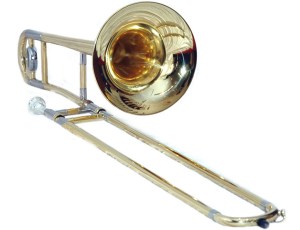
I tried to play this!
I used to be almost immersed in silence. Silence was a steady drumbeat which echoed in my ears. Some days during elementary and middle school I could have easily counted the number of words I spoke.
I was shy. At home and around our neighborhood, I was confident, talkative, proud of my athletic abilities, and even a little pushy, but at school I walked around like a soldier. I walked gingerly, my eyes darting around, like cat eyes do when they’re sensing danger. None of it made logical sense. As a young boy, I simply feared the unknown. I was afraid someone would say something weird to me, or ask me to do something I couldn’t do well, or force me to do something I just didn’t want to do. I didn’t know what to do when older boys threw around curse words, or talked crudely about girls, or behaved aggressively.
I walked the two miles from our charming old two-story house to my elementary school. As I walked my ten-year old self down South Broad Street and turned onto Beebe Avenue, everything around me seemed extra-large. The houses looked like castles and the oak trees looked like giant redwood trees. The main street in my small town looked as wide as a Los Angeles freeway.
When I got to the end of Broad Street, a sweet older lady wearing a bright yellow vest stood in the middle of the street to stop traffic so us little people could cross safely. “Come on honey, get across quickly,” she’d yell to me in a squeaky voice as I scooted past her on the cross walk. As I started down Beebe Avenue, I could see my smallish school at the end of the dead-end street.
My brother and I loved to read as soon as we learned how to in first grade. I gobbled up Hardy Boys mysteries, biographies, and books about American history, reading many nights in bed until it was time to turn the lights off. I did well in elementary school because I enjoyed learning new things. I was popular with the teachers because I loved going to the library and because I actually enjoyed many of the lessons being taught. My respectful nature generally inspired praise from the adults around me.
Despite my successes, school was still a scary place for me. I didn’t like the unpredictability I encountered every day. During my preschool years, I was nurtured and protected by my parents. I knew what to expect in our house and around our block. School, on the other hand, was a place full of kids I didn’t know and adults who were paid to challenge me.
It was during the fifth grade that I enrolled in the band. I loved music, but I didn’t go to anyone and say, “Hey, can I sign up for the school band?” I assume the decision was made by my parents. I’m sure they wanted to help make me into a well-rounded youngster. Once the idea of becoming a musician was thrust upon me, I did take up the reins and try to gain control of the situation. I decided I wanted to be cool and play the drums. As a kid, I loved to drum my fingers on our wooden dining room table, or on the windows, or anywhere else I could find a place to lay down a beat.
“I want to be a drummer,” I told my Mom one day. (I opened up more about my feelings and desires with my Mom than I did with anyone else, often talking with her while she was cooking dinner or doing other household stuff.)
“We’ll see Michael,” she responded.
“We’ll see” meant that I was going to be able to choose on my own. The process of finding an instrument turned out to be pretty random. My immediate musical future was determined by the luck of the draw. The band director, who had been handing out instruments for about twenty-five years, gave me whatever was leftover after the older kids had gotten their equipment.
Mr. Spang ended up giving me a trombone. He handed me the case, and said, “This is your instrument son…good luck.” Damn…I didn’t want to play the trombone. It was like going into Ben & Jerrys to get a chocolate milk shake and instead the store clerk hands you a glass of tomato juice. If I couldn’t play the drums, I would have chosen the trumpet, but I never would have chosen a trombone. When I took the instrument out of its worn brown case, it seemed old-fashioned and unfriendly, like a foreign object an old man would play on the Lawrence Welk show.
As I looked it over, I could see that the trombone had lost its youthful shine. It had nicks and scratches and quite a few dull spots where the gold exterior had become worn. It did play, though…notes did come out of it, notes which sounded like the noises an elephants make—sort of low and ponderous.
I tried to make the best of the situation. After awhile, I actually started to feel good about having my own instrument. I still didn’t love the trombone, but I really liked making music.
“Mom, come in my room and I’ll play something for you,” I whispered to my Mom one day, about two weeks after I started practicing.
“Bob, come here, Mike’s going to play something for us.”
My parents shuffled into my bedroom and I stood in the middle of the floor and belted out “Camptown Races” and a few other cute little songs for them. I had learned how to slide the slide thingy to the proper place in order to play the proper notes. The notes on the page had numbers next to them, and if I remember right, there were six positions I could choose from.
My parents were pleased and I was happy being able to play something for them. It was after this beginning stage, though, that trouble started. The trouble began when the notes in the song book no longer had numbers next to them. The other problem was that we started playing songs I had never heard before. Big problem! I went from a contented new musician to feeling like the captain of a leaky ship who is lost in the middle of the Atlantic at night in a dense fog. Once things got more complicated, I just couldn’t keep up. When I didn’t know the tunes, I didn’t know if I was hitting the right notes.
Despite my highly strained relationship with the trombone, I was confident about the fact that I did have some natural abilities. I had already established the fact that I could eat massive amounts of food in one sitting, chug a pitcher of sweet tea without stopping, and accurately shoot a basketball from any spot on the court.
None of these abilities were helpful, though, as I tried to understand the subtleties of playing the trombone. Inhaling the ten slices of pizza contained in a large pizza box from Nina’s pizzeria was easy. Understanding the nuances involved in conquering an instrument was apparently beyond my reach.
Mr. Spang gave us all private lessons. I’d leave my regular classroom and slowly walk down the narrow hallway to the auditorium where Mr. Spang was waiting for me. I have absolutely no idea why he didn’t put me out of my misery once I started sucking so bad. Maybe he was simply pleased that I showed up for practice? Maybe he thought I’d get better? Maybe I’d find out later that a lot of my fellow players were also pretty bad?
Soon after lessons started, I found out that we were all going to play together and eventually our band would do concerts for the public. Oh, my God! Concerts for the public? Are you kidding me? Unless we only played “Camptown Races,” I was about to be humiliated. I assumed the other band members could pull it off, but there was no way I was ready to help entertain an audience.
Wayne Wright was the one other trombone player in our band. Once we all started practicing together (there were about thirty-five band members) on the big stage, it became clear to me that Wayne knew what he was doing. As I listened to him play, I decided he played like Glenn Miller or Louis Armstrong, while I played like Bozo the Clown. I just couldn’t keep up. I couldn’t read most of the notes or play at the right tempo. I needed a way out of this mess. I decided to do the only thing I could think of that would allow me to fulfill my obligation to the band and my parents and still not have to reveal my glaring imperfections. While everyone else played during rehearsals, I decided that I would basically hang out. I’d sit there and fake blowing into the mouthpiece. At the same time I puffed up my cheeks to simulate playing, I also slid the slide thingy wherever Wayne slid his. I did produce a range of muffled sounds to more or less echo Wayne’s playing, but basically I was a big fat faker.
We all dressed up smartly for the first concert in our cute suits and dresses. I wore a white sport shirt, black tie, and sport jacket. The whole atmosphere at the concert was amazing. Mr. Spang loomed large in front of us with his music stick, standing perfectly erect, imploring us to relax and play powerfully. “Okay everyone,” he whispered as loud as he could. “Do it just the way we practiced. Keep breathing and project out to the audience.” His well placed words of encouragement were, of course, irrelevant to me since I didn’t plan on playing. On the other hand, I was following one bit of his advice…I was going to play exactly the same way I did in practice.
The audience of about two hundred people was out there in the dark. Wayne and I were in the first row at the far right. I looked over at Wayne and saw that he looked relaxed and ready. And then suddenly, while I was staring at Wayne’s well polished trombone, we started playing. Mr. Spang raised his hands and we were off to the races. As soon as the music started, it was as if the ship had pulled away from the dock and I was left standing there by myself, watching something I was supposed to be a part of drift away from me. Everyone else played while I passively participated like a cute character in a Norman Rockwell painting.
I have no idea what songs we played. I sweated my way through the whole thing, constantly peeking sideways at Wayne to see where I should slide my handle, relieved when each piece ended and I could listen to the applause that the others had earned. Throughout the concert I looked out at the crowd to see if they looked pleased, and then I’d look back at Mr. Spang to see if he was still smiling.
We went through a few more concerts the same way. My parents, who came to every concert, told me how wonderful it was that I was performing for people. I was ashamed of myself for not telling them about the fakery, but I was too scared to tell the truth.
Thank God Wayne kept showing up. If he had missed a concert, I would have been sunk. No sound would have come from the tiny trombone section. It went on that way until I quit at the end of the season. I knew I couldn’t keep doing what I was doing. The lying was wearing me out, making me feel like a coward and a failure. My timid young soul couldn’t comprehend that it would have been easier to tell the truth. I could have just said, “Hey Mom and Dad, the truth is that I’m really, really bad at this. I’m not good enough to play in the concerts.” Instead, I thought I should just do what I was told to do. And, if I couldn’t do that, then I should fake doing what I was told to do.
The other reason I quit was because I knew I couldn’t fake my way through future membership in the marching band. If I couldn’t play while sitting in a chair with a giant music book in front of me, then I certainly couldn’t play while high-stepping it down the street. Plus, I assume Mr. Spang would have eventually pulled the plug on the whole thing anyway.
As I got older and made my way through high school, my misstep with the trombone became a somewhat distant memory. At the same time, my love for music grew. I was easily moved by a cool song or a great singer. I fantasized about being a piano player, or a drummer, or a singer.
During high school, I began listening to Elvis Presley. I didn’t respect his overall music abilities the way I respected Springsteen, Clapton, Bowie, and others. I knew Elvis was cheesy and a little goofy, but damn…I loved and admired his voice and his larger than life personality on stage.
As I saw more of his old concerts replayed on TV, I began to imitate him. It was pure fun. I’d sing all of his big hits in a deep voice, with all the dramatic vocal vibrations included. I’d also talk like him, saying stuff like, “I love you Mama…could you make me another peanut butter and banana sandwich?” I loved the way he called his mother “Mama,” and I thought it was cool that he ate weird sandwiches.
I got in trouble when I sang like Elvis in church. Mom thought it was wrong to sing “all crazy” when you’re singing a church hymn. If she was really embarrassed, she’d lean over toward me and forcefully whisper in my ear…”Michael. stop singing like Elvis…sing normal.” I could feel the hotness of her breath and hear the earnestness in her voice as she delivered the concise message. She was determined, as always, to not be embarrassed in public.
During the last part of high school and especially in college, my basic shyness in public began to melt away. In addition to bringing my Elvis voice to church, I was exposing my inner self in lots of other settings too. I became more assertive playing sports, became more honest, more authentic, and more vocal around new people. I still often avoided complicated confrontations; but, at the same time, I was emerging from the shadows. Around my sophomore year of college, I decided to tell my parents about what happened back at Perry Browne elementary school.
“Hey you guys, do you remember when I was in the band at Perry Browne?” I asked them that one time when I was home for the weekend and we were all sitting around the comfy living room.
“Of course we do,” they answered. “We were proud of you for doing that.”
“Well, I want to tell you something about that.”
“What about it?”
“Here’s the thing…during the concerts…I didn’t actually play.”
“What do you mean you didn’t play?”
“I just slid the handle wherever Wayne slid his. I couldn’t play the notes right.”
After they took a couple of minutes to get over the initial shock, we all got a good laugh out of it. I explained how I wasn’t anywhere near good enough to keep up with the band. We all laughed a lot as we talked about what would have happened if Wayne hadn’t shown up for one of the concerts.
During most of my school years in Norwich, I decided that keeping my mouth shut was often the best policy. It was the best way for me to avoid people and things I didn’t want to deal with. Generally speaking, my school boy policy of avoiding tough challenges certainly wasn’t a healthy thing. It would have been better if I had the courage to keep going when confronted with things that made me uncomfortable.
In the case of the trombone, however, I probably made the right decision. Given how badly I played the thing, it probably was better that I turned it into a silent trombone.
_______________________________________
THE MILK BOTTLE

Milk bottle
One night, many years ago, my brother Tim, my mother and I sat eating dinner without my Dad. We were eating at the big old table in the rambling old Brown Avenue house that we lived in until I was eleven. I don’t remember the particulars, but I guess that my brother and I were fighting, or had talked too much, or had done something else that was annoying my mother. She told us to stop, and we didn’t, and then she yelled for us to stop and slammed down a milk bottle on the table for emphasis.
The glass shattered and cut her wrist. She screamed and moaned softly, and a red puddle spread over her part of the table. My brother and I turned in the other direction and darted upstairs to our bedroom. I was nine years old and my brother about seven.
We went downstairs after a long time and found red spots leading out the door to our neighbor’s house. Our neighbor, thankfully, was a nurse. She was a nurse…we were cowards.
My father came home later and told us that Mom was at the hospital and would have to stay there that night. She had severed some nerves in her wrist and they had to do minor surgery in order to close the wound.
My mother never complained about this incident. She is humble, forgiving, caring, and self contained.
Years later, she was in the basement playing the dusty piano that had sat there for years. I didn’t even know that she played. I’ve always had to prod her in order to get things out of her about her childhood or her ambitions. It makes me uncomfortable. I wish she would express her ambitions more often.
As she played the piano in the basement, she wrung her hand and said that she couldn’t feel the keys very well. I asked her why. She whispered something about the feeling in her fingers not being very good and quickly said something about her wrist. She didn’t, though, mention the milk bottle. Once again, she didn’t complain or whine. I think she’s protecting our feelings, or, I guess, just practicing humility.
As I stood behind her and watched her continue to try to manipulate the keys, I didn’t know what to say. I knew it wasn’t our fault that the glass shattered: but, that aside, I felt clumsy and stupid in the face of her tolerance and silence.
______________________________________________
HALE ROAD
When I was eleven, my parents announced to me and my brother Tim that we were moving from Brown Avenue within the city limits to Hale Road, just outside the city limits. Tim was nine at the time. The two of us, of course, had no choice in the matter. We were, I think, sad to leave our childhood home, but excited for the new adventure.
Though the new house was only about two miles out-of-town, it seemed in some ways like we were moving to another part of planet Earth. The Brown Avenue house was over a hundred years old and was surrounded by other old homes and many majestic ancient trees, giving the street a cozy closed in feeling typical of a small town neighborhood.
The Hale Road house, on the other hand, was only about twenty years old and was sunnier and obviously more modern. It had lots of large windows and wasn’t enveloped by trees. It also had a very big yard (Brown Avenue had a tiny yard) and vast tracts of fields and woods behind it. I remember thinking that the house was more sophisticated and sort of a marvel because the light switches were push button (which I had never seen before). As an eleven year old, I was impressed by things like funky light switches. The whole place was an update from our previous dwelling. I loved the nooks and crannies and old-time charm in our old place, but I was energized by the freshness of our new residence.
In terms of architecture and financial standing there was a lot of diversity in the new “neighborhood.” There were modest houses in the neighborhood (including ours), but there were also doctors and business owners who lived around us. Speaking of the diversity…we actually had an old farmhouse on one side of us. The owners had one horse which usually roamed in the fenced in part of the field that surrounded us on two sides (I fed the horse carrots a lot because he could saunter right over to our side yard when he wanted to). On the other side of us was a house owned by the owner of a local car dealership. Al Nasser and his family had a relatively new house and a nice in-ground pool surrounded by a fence. After we got settled, us kids often pretended to accidentally throw a ball over their fence so we’d have to go retrieve it. When we knocked on their door on a particularly hot summer day to tell them our version of what had happened, we’d always be hoping they’d invite us to go swimming (which they sometimes did). I’m sure they knew it was not an accident that the ball was flying over their fence two or three times a week, but they never asked us to admit to our simple trickery.
We played kick the can, basketball, softball, soccer, baseball, and anything else we could think of in our yard or in other people’s yards. There were lots of other kids more or less our age all over the neighborhood (Mike & Stu Aronson, Jim & Norm Money, Jeff Walker, Dave Brown, Kim Clark, the Smith brothers, Michelle Herrit, Doug Marchant, and more ) and we’d coordinate with each other over the phone to meet in some corner of the neighborhood in order to play more games (we played at all hours of the day and early evening). The only things that ever stopped us from playing were school, or meals, or some family obligation. We played kick the can at night a lot. Playing after the sun went down added an element of suspense because kids would startle you as they suddenly dashed out from the inky black shadows to try to kick the can before whoever was guarding it could get back to it. There was one outside light shining on the can, the rest of the backyard was only illuminated by whatever sliver of moonlight was out that night. Because it got cooler at night, we’d be breaking out in cold sweats as we calculated our next sprint toward the can. During late afternoons, we often continued playing baseball or football or basketball as the sun went down behind the hill, until we just couldn’t possibly see the ball anymore.
Soon after moving in, on August 20th 1970, we went through a second very big change. Mom delivered Chris and brought him home from Chenango Memorial Hospital. She had shocked me and Tim (after shocking Dad in private sometime earlier) back at Brown Avenue when she announced she was pregnant. She announced it to us at the dinner table one night as we began eating. She delivered the big news in her typical low-key straightforward quiet way. “Boys, your father and I have something to tell you…I’m going to have a baby.”
I vaguely remember silence lasting for more than a few seconds as we tried to digest what she was saying. I definitely remember thinking…What is she talking about? How could she be having a baby? We already had our family, right? It never entered my mind that we’d ever have a another brother or sister come along. I was eleven and Tim was halfway to ten, so our little family had stayed the same for a long time. Plus, I didn’t think of my Mom as a baby making person. I just thought of her as our Mom, nothing else. I didn’t even think of her as a wife to Dad. As far as I was concerned, she existed to make the world seem safe and cozy for me and Tim.
I remember Tim and I waiting for Mom and Dad at the top of the driveway so we could see our new baby brother and welcome Mom home. Even as unsophisticated elementary school kids, we knew that Mom had just gone through a lot. We also knew that baby Chris was going to dominate the scene for a while. “Be careful with him,” my Mom said, as she pulled the yellow blanket away from his face and held little Chris out to us in the driveway for inspection. It was the adult version of show and tell.
I immediately loved having a little brother. There was obviously no competition between us, like there often is between brothers close in age. (I secretly liked Tim, but I picked on him a lot and competed with him athletically and in other ways—it wasn’t a pretty sight). I enjoyed helping Mom take care of Chris. I changed his diapers (Mom patiently showed me how to do it without getting crap all over the place), helped feed him, and took him around the neighborhood to show him off to everyone. He was very cute. Tim and I both liked taking him around the neighborhood with us. Tim loved him every bit as much as I did. (By the way, we had also brought our beagle, named Penny, with us from Brown Avenue—so we had a pretty good-sized family in our new home.)
As things got settled, we got back into the same routine we’d always been in—except that having Chris around obviously added a fresh flavor to things. As Mom got back to full strength, she was the main adult presence in the house because Dad was often away teaching, or going to meetings, or fulfilling his duties as Norwich Fire Chief. Dad was an immensely powerful presence when he was home, but he just wasn’t there much. He used his leadership skills and intelligence to move his career forward and to provide for us in every way possible.
My brothers and I were hugely influenced by him, though. To me and Tim, Dad seemed like Apollo and Zeus rolled into one. We were intimidated by him on the one hand, but we were also immensely respectful of his talents, energy, raw strength, and devotion to the family. We also enjoyed his love for randomly whistling snappy tunes like “Downtown” by Petula Clark, and listening to the 1812 Overture, and telling corny jokes. We also liked the fact that he initiated vacation trips up and down the east coast. We went to Carolina Beach, Mystic Seaport, Plymouth Rock, Virginia Beach, Williamsburg, and many, many other places. As kids, we didn’t always appreciate the fact that we camped a lot (from our perspective, it was too much work and the locations were a little too isolated), but we did enjoy going on lots of trips to places we hadn’t seen before. It was cool to experience things outside of our little world.
There were few things cozier or sweeter than watching Mom move around the bright new kitchen with her red and white apron on as she prepared meals for her boys. Mom did the vast majority of the work around the house and in the kitchen. When Chris, Tim, and I were in the kitchen, it was usually because we wanted to stick our fingers in a bowl filled with cookie dough. Laziness was about 92% of the reason we didn’t help much (I helped a lot more when I got to high school), but there was another reason too. Mom told us she preferred cooking by herself. “It’s just plain easier to do it myself than to have you guys in here. You just make sure that I don’t clear the dishes after dinner.”
The bottom line was this: She was the culinary conductor, the stove and utensils were her instruments, and we were her appreciative audience. In the middle of dinner preparation our little kitchen pulsated with wholesome energy. Steam and delicious smells floated around the room. Meaty dishes sizzled in the oven and the ingredients for pies or cakes or cookies often covered the counter. Heat radiated from the stove and condensation fogged up the windows. Most strikingly, there was the sense that Mom was doing all the hard work because she card about our well-being more than anything in the world.
(To Be Finished Soon!)
PART II: THE COLLEGE YEARS
OSWEGO
Note To Self: INCLUDE STORY ABOUT DOWN HILL SKIING WITH ANDY
(Essays about Oswego—including stuff about best friend’s Andy, Ellen, Val, Ronnie, Hart, Gary, and many others—TO BE ADDED)
______________________________________
GIVE ME MY MONEY

She wouldn’t give me my money!
In those quaint times before ATM machines came around, people often needed to make sure they had enough cash on hand before the banks closed on Friday afternoons. One Friday, while I was still in college at Oswego, I went to my regular bank to cash a check my parents had generously sent to me. If I didn’t cash it, I would have zero dollars for the weekend. I never had a car during my college years (and for a number of years after college), so I got around by walking, taking the bus, or riding my bike.
On this particular Friday in the middle of the semester, I was riding my bike. I quickly pedaled to the bank late in the afternoon to get there before closing time. I arrived too late to get into the lobby; thankfully, however, the drive-thru was still open. There was no one around other than me—no cars, no people, nothing. I pedaled my bike up to the window and looked at the cashier behind the microphone. She was sitting in a chair, back straight, sitting perfectly still, staring straight ahead, as if she thought she’d be paid extra money if her posture was picture perfect.
While straddling the bike, I put my mouth near the hole in the glass and yelled out my request. “I need you to cash my check, please.”
I waited for the woman to pull the lever and push out the metal box under the window so I could place my check inside. Instead the lady was saying something to me, using their shoddy sound system. She was hunched over, speaking directly into her microphone. The words were garbled, but I sensed she was communicating a negative message to me.
“What are you saying?” I responded, also hunched over, trying to get my mouth nearer to the tiny hole I was forced to speak through.
“I can’t wait on you,” she said. “You have to be in a car to be waited on at the drive-thru.” This time I could hear all of what she said, loud and clear. In the time it took me to process her abrupt proclamation, the check could have been cashed and I could have been on my way to spending the precious money on cheap beer, roast beef subs, or pizza slices. I looked at her closely, trying to understand what she was about, not believing she was being so rigid. All I needed her to do was grab my check and give me my cash.
“You really can’t help me?” I asked.
“No, I can’t…you have to be in a car,” she repeated emphatically, speaking with the confidence one exudes when they’re holding all the cards and have a glass barrier between them and the customer.
“This is the only way I can get money…and it’s not like I’m walking…I’m on a bike. Could you please help me out.”
“I can’t do it,” she repeated.
I could see it was useless to say anything else. Neither charm, nor wit, or some kind of sustained argument was going to make any difference. I pulled my bike about twenty-five feet away from the window and turned back toward her. I was not going to let the bank deny me my money. I was going to outwit them somehow.
She and I were still the only ones around. The bank was somewhat isolated, sitting near the edge of the campus, where there were no other buildings around. It was a nice sunny afternoon—no wind, no clouds, blue sky. It was a Friday in a college town, the kind of day when anything seems possible. The cashier and I faced each other like two gunslingers, except that…while I stared in her direction, she ignored me.
It took me about a minute to come up with a plan. When I was sure of the details, I took one more glance at the window and then rode around to the front of the bank. After about ten minutes, a worn out yellow station wagon pulled into the bank entrance. I waved my arms over my head to get the driver to stop and talk with me. He eased up next to me and gingerly rolled the window down, casting a suspicious look my way.
“Hey, how ya doing,” I said. “I need a big favor from you.” The man was probably in his early thirties. There was no one else in the car with him. He was an average looking guy, standard hair cut, plain clothes, a calm face.
“What kind of favor?” he responded flatly.
“I rode up to the drive-thru on my bike a few minutes ago and the cashier wouldn’t cash my check because I wasn’t in a car. It wasn’t like I was walking! Plus, there was no one else around. Can you believe they wouldn’t help me!” I talked fast in order to kind of overwhelm him with the rightness of my cause. I watched his face to see whether he seemed to agree with my assessment of things. As I emphasized the part about the cashier denying me the money, he made a sour face.
“Would you let me get into your car and ride with you while you go to the window, so I can cash my check?” I then held up the check so he could see it.
The guy paused, looked at me closely, and then said, “Yeah, I’ll help you…get in the car.”
“Thank you! I really appreciate it!” After thanking him, I layed my bike down on the grass and got in the front seat next to the stranger.
The guy turned his head toward me and said, “I’m just cashing a check too.”
I ignored that comment, and again said… “Thanks for doing this.”
We glided up to the window and the dude easily got his simple transaction taken care of. Then I handed him my check and ID so he could pass them to the cashier. I leaned way over toward the driver side so she could see my face. She looked at me, but didn’t react in any dramatic way. She was a cool customer. She stamped my check and passed the precious cash out to my new friend. He handed the bills over to me, smiling as he did it.
It was over. I didn’t gloat. I didn’t yell crap at the cashier. I just got my money and momentarily savored the small victory. I profusely thanked the man again, hopped out of his car, and then walked around to the front of the bank to get my bike. As I left the parking lot with the needed cash in my wallet, I was happy that imagination and non-conformity had prevailed.
PART III: THE ALBANY YEARS
PARSONS AND ROXANNE
My first job after college was going door to door setting up appointments for the grizzled older salesman at an aluminum siding company in Albany, N.Y. I moved to Albany immediately after graduating from SUNY at Oswego in order to live near Andy, Ellen, and Val, my three best friends at Oswego.
(TO BE FINISHED)
________________________________________
POVERTY

Potatoes
I was standing, or, I should say, slumping in the kitchen. My legs were sort of numb, or chilled, or perhaps dead–if one part of your body can die. I was working for a landscaping company in Albany, N.Y. It was a few years after graduating from college and I was living with my friend Val (a friend from my college years) and her boyfriend Bernie in an apartment on Madison Avenue, near the Capitol building in the downtown area of the city. After quitting a teaching job at a place called Parsons (because I was burnt out), I took the low wage job out of necessity—and I moved in with Bernie and Val to split the rent and save money.
It had been a particularly leg numbing day while landscaping. Calling it landscaping is funny. Actually, while others landscaped, I mowed lawns. I mowed lawns over, and over, and over again. We hauled around grungy mowers in the back of a grungy pickup truck, and scurried to unload them at one beautiful home after another–homes “blessed” with vast tracts of land which the owners chose to call lawns.
We would scurry around, spilling gas, slamming the mowers, bitching about how rich the home owners were, and then we would push those mowers as fast as our feet could move them.
You see, of course, more lawns done….more profit. So we sucked it up—owners included. We all busted our butts. Somewhere between five and ten of us would descend on a home and devour its grass.
I felt like such a schmuck when I peered thru rich people’s windows. They were rich and I was struggling to pay my rent. You see, those vast profits reaped by the #1 LAWN SERVICE did not, like Ronald Reagan’s theory, trickle down to me, or the other lawn cutters. We were low men on a wildly imbalanced totem pole.
My brain, however, deprived of vital nutrition, was not able to function well enough to encourage me to complain, or leave. I was on automatic pilot(automatic poor pilot).
So, after one of the exhausting days at work I limped into our kitchen to get something to eat, to try to get some of my energy back. My cat, Zoie, arrived in the kitchen at the same time. I knew what he wanted–more of those succulent, soft, chewy little cat morsels.
I had been living on potatoes and mayonnaise for weeks. My coup de grace was an occasional cheese topping. That night, however, I was going to splurge. I felt like I had to go to the grocery store and get something a little extra, maybe some ice cream or some cookies. But, I soon realized that I was out of cat food and I only had enough money to buy food for Zoie or get a treat for me, not both. I looked at Zoie, and Zoie looked at me. I immediately knew that I certainly couldn’t deprive him of food. He was dependent on me. It was sick! I was going to go to the grocery store and get cat food, and then stride back home and boil more potatoes.
Something funny happened though; I damn well loved those potatoes. I can taste them right now. It was stressful as hell to not have enough money; but at the same time, as I think about it now, it also seemed sort of comforting, in a weird sort of Zen-like way.
It was me and those potatoes, and Zoie and his little morsels. It was pathetic in its striving, but somehow noble in its simplicity. I can’t believe that I have ended up saying that it was comforting to end up the day weary and drooping, watching a pot full of potatoes boiling; but I am finding the thought comforting. I guess the truly pathetic time would have been when there were NO potatoes.
_______________________________________________
TAKING OFF THE BLINDERS
We all know people who turn out not to be entirely who they seemed to be. There are people who, when you get them alone, surprise you with their ideas, or their candor, or their choice of shampoo.
Well, my Mom—damn—I don’t know where to start. My Mom has demonstrated her humble and unassuming nature many times. She is quiet, serene, and utterly nice. She’s a church secretary. She wears cute sweaters and colorful scarves, makes fabulous meat loaf and delicious pumpkin pies.
Long after my childhood years had ended, I received a letter from my Mom— typed on a computer. It was peppered with exclamation points and passages filled with flourishes about wine and cheese, candles, cozy chairs, and other things she thinks should surround me. She talked in the letter about her family coming to America, about her pride in their accomplishments, and about the way my name is spelled in Scotland.
Is this my Mom talking? In my experience, she had rarely expressed those kinds of thoughts. Instead, for years, she listened to her husband and kids. She nurtured us. She cooked as if she was a food angel, cleaned up without a whimper, washed us, nursed us, and clothed us. She did it without a word of pity, and seemingly without introspection. She plugged on relentlessly, dealing with grocery lists, haircuts, laundry piles, bank statements, doctor visits, and bag lunches. We rarely heard an extra peep from her, rarely a complaint.
Her mother died of cancer when my Mom was thirteen. Her father was a railroad man. He was immensely quiet and dignified. They lived in a house, built in a tiny town. It was my Mom, primarily, who took care of Grandpa Neish after Grandma died.
“It must have been hard for you back then?” I said to her one day. She looked at me perplexed.
“It must have been hard taking care of Grandpa,” I repeat.
“I don’t know,” she says.
Now, I get this letter. She can write! She has a flair for writing that I hadn’t suspected. Who could have known? In two tiny sentences she sums up most of my desires. Then, after just a couple more paragraphs, she says, “Jeez, listen to me ramble.”
At Christmas time last year, I told her I was feeling a little lonely and discouraged in my Albany apartment after quitting a job and seeing a couple of good friends move away. That’s when she gave me a sweater and a comforter. A couple of weeks later, I got the letter in the mail.
She is unbelievable. A lot of people may only know her as a loyal and loving church secretary and wife. She is much more than that. She is also a creative writer, a historian, a strong dynamic woman, and a guardian angel for three boys—three boys who are only now seeing her clearly.
__________________________________________
LIVING WITH WEIRD JACK
My first summer after college was filled with fun in the sun, hanging out with friends, and many, many hours of playing b-ball at the park. After settling into a teaching job in the fall, I ended up living in a tiny dwelling near downtown Albany, N.Y. I had no phone, which meant that I had to make and receive calls at a pay phone in the cavernous hallway of the adjoining building, a sort of weird hotel. The place had marble floors, stone walls, and extremely high ceilings. When I talked on the phone, my words echoed back at me like the sounds of coal miners talking inside a tunnel.
The main problem was that I was too alone there. I was living on Willett Street, near spacious Washington Square park, about five blocks from the Capitol building. Watching people in the park was cool, but that was the point…I was just watching, not participating. I needed people around. I needed a phone hook up. I needed a kitchen. I needed furniture (other than the abandoned mattress I hauled in off the curb to sleep on). I needed to say goodbye to the uninvited cockroaches that occasionally marched into the light. I’m a minimalist, but I needed more than what I had in my tiny Willett Street apartment.
“I know a place you could move into,” my friend Doug told me one day. Doug was a guy I had met my first summer in Albany. He was a down-to-earth, athletic, plain speaking, fun-loving guy from a small town near where I grew up. Doug quit the SUNY Albany football team because of a chronic ankle problem, but still managed to get in pick up games with me almost every day at the park during the summer. When we got home, we’d plop down on Doug’s tattered couch, suck down a pitcher of iced tea, and recount the details of our heroics on the basketball court. By the time I was ready to move away from Willett Street, Doug and I had become very good friends. When he mentioned that he knew a place I could move to, I was very glad to find out he had an idea I could listen to.
“Tara’s roommate has a boyfriend who is looking for a housemate.” He’s looking for someone to move in with him on the second floor of a two-story house.”
“Damn, I’ll definitely talk to him,” I replied. “You know I need to get out of the place I’m in now.”
A few days after talking with Doug I went to the house to meet the guy. The house was on Western Avenue. The young man I met was named Jack. He had long shoulder length frizzy hair, a high forehead, narrow face, and lily-white skin. I really didn’t need to learn much about the place. Yes, the old house was a little rickety and Jack was slightly aloof, but I didn’t need to be convinced to make the move. Jack told me the amount of the rent and I quickly agreed to move in.
At the moment I agreed to move in, I believed anything would be better than the petite apartment I was living in. The main positives were its close proximity to the college, its ripe old age, its large size, and the fact that it was fully furnished. My new house had high ceilings, lots of wood, and a certain old-time charm. It was also worn in many places, and it had sloped floors, a crappy bathroom, cracked floors and walls, and a dingy kitchen.
After only a few days, I started giving Doug detailed reports about the place because I almost immediately didn’t like the vibe I was getting from Jack. I began by telling Doug about how Jack always kept the heavy maroon curtains tightly closed and the lights turned way down low, keeping the house eerily dark. I told him about how Jack kept candles lit in the living room for most of the day. I’m generally a very big fan of candles, but in this case Jack’s candle lighting seemed oddly random and out-of-place. When he and his girlfriend Amy weren’t lighting candles or silently shuffling between the bedroom and the living room, they were earnestly whispering to each other.
They always wore dark clothes, which made their skin look very white. Their clothes and skin color matched their stone faced demeanor. It was like living with Dracula. By the way, Tara had barely met Jack because Jack never went to Tara and Amy’s dorm room to visit. So, Tara didn’t know enough about Jack to warn me about his dark vibe. I don’t think he liked to leave his darkened cozy sanctuary unless he had to.
Doug would laugh uproariously as I enthusiastically described how freaky the two of them were together. In Jack and Amy’s relationship dance there was no bright light, no color, no robust eating, little laughter, and only a few coy smiles.
“What the hell is up with these two?” I’d ask Doug.
“I don’t know,” Doug would spit out through his laughter.
“What have I gotten myself into in this place?” I added.
Doug was baffled by Jack’s behavior. Doug and I thought the scene in the house seemed like a festival of creepiness. Whenever we talked about Jack, I ended up laughing too. I didn’t take any of it too seriously. By themselves, the candles, the clothes, and the constant whispering were only creepy because of the consistency of the darkness. The thing that really caught my attention was my unsubstantiated belief that there was something just plain unbalanced about Jack’s character and personality, something that existed beneath the surface. Then, as time went by, an unexpected thing happened—Jack actually started to scare me.
A few sinister things happened. One thing I noticed was the consistent flatness of his personality; he rarely wavered from his mellow monotone speaking style. The other thing was that I began receiving calls from people who said that Jack owed them money, and that it was urgent that he get in touch with them. Jack never answered the phone—ever; so in the age just before answering machines I was left to take his messages. As the callers got more agitated, they’d give me more and more details.
“You tell him that he owes us lots of money and we’re not going to give up until we get it from him.” As the calls got more frequent, I started to aggressively ask for details, partly so I could pass on the juicy info to Doug, and partly because I couldn’t believe the breadth of Jack’s fraudulent behavior. There must have been ten different businesses or individuals who called to say Jack was ripping them off. Many of the messages included threats to call the police.
When I passed on the messages to Jack, he would calmly tell me clever stories in order to cover up his trail of deceit. He’d end his explanation by saying, “Oh look Mike, it’s just a misunderstanding.”
“Oh yeah, that’s a lot of misunderstandings!” I’d sarcastically say to Doug. After awhile, I stopped asking Jack about the calls because hearing him coldly lie to me gave me the chills. At our regular “Jack Update” meetings, Doug and I started to talk about how Jack was more than a little weird; he actually seemed to be a very bad man.
I also started to notice tiny things moved around in my room. I suspected that Jack was going into my bedroom while I was gone. I imagined him lightly moving around in there, spying, turning things over, trying to find out something about me. He had a way of moving around the house quietly, so that even when I didn’t think he was home, he would suddenly emerge from around a corner, like an undetected submarine rising from beneath murky waters.
I also saw a gun in Jack’s room. He said it was a starter’s pistol leftover from his days running track in high school. I didn’t believe him. The only time I could imagine him running was if the police were chasing him.
“How could a ghoulish character like Jack end up going out with sweet Tara’s roommate?” I asked Doug.
“I don’t know,” Doug answered, baffled as always by Jack’s quirkiness. Doug was spooked by Jack, but he was also entertained by the intrigue. We’d sit in the living room and exchange information while Jack was out of the house. Telling Doug the stories inside the darkened house made them seem even more chilling. Doug and I were afraid to open the curtains and lighten up the house, even when Jack wasn’t there. In our wildest imaginings, I think we both secretly believed that Jack might try to hurt us, or even murder us, if we did something to upset him.
About a month after I moved in, two other guys moved in with us. Gordon was a totally cool guy, laid back, sort of a hippie, smart, solid in every way. Pat was a skinny fella, perpetually smiling, always bragging about things that seemed made up. For instance, he said he was a great singer…but he wasn’t. He was a terrible singer. He carried around a guitar, but he couldn’t do anything with it but a little very simple strumming. I don’t know where he got money for rent. He didn’t have a job. Gordon, on the other hand, was working on getting a Masters. I told Doug that I was glad to now have a buffer between me and Jack.
After all the phone calls about Jack, I began to think about what other weird things Jack might be involved in. I began wondering if he might be doing something strange with our rent checks. Jack was collecting our checks and taking them to the landlord. In the beginning that seemed like an acceptable arrangement, but now I didn’t trust him anymore.
“I think Jack is up to something. I’ve told you about all the crap he’s done in the past,” I said to Gordon one day. “Will you go see the landlord with me?” Gordon hesitated, but agreed to go along if it wouldn’t take too long.
We went to see the landlord in his business office and found out that he was one of the richest men in Albany. It didn’t take long to discover that Jack had been doing something devious. It turned out that our landlord had not gotten a single check from us in the last three months. Believe it or not, because the landlord had so many properties, his office hadn’t noticed yet that he hadn’t received the money. We all, including the landlord, realized that Jack had brazenly forged the landlord’s name and simply cashed the checks. When we showed the landlord the cancelled checks, he confirmed that it wasn’t his signature on the back.
His first reaction was to tell us that we still had to pay him. “Gentlemen, I don’t care about your problems. I want my money!” We finally convinced him that we shouldn’t have to pay twice, and then we scurried out of his office.
The next thing was to confront Jack. He had played us for fools, and he had committed a felony! It somehow turned out that I was left to talk with Jack by myself, probably because I was the one who was the most enthusiastic about tracking down his trail of badness.
“What did you do with our checks?” I asked Jack when he got home. (I spoke a little timidly at first because I wasn’t sure how he’d react to being cornered.)
“I gave them to the landlord. You know that. Why are you asking?”
“He never got them from you. We just talked to him.”
“Well…I gave them to him. Someone has made a mistake.”
I can still picture Jack standing in front of me in the hallway, staring at me calmly. He coolly answered my questions as if he had the slowest pulse in human history. He was unflappable. Knowing he was speaking a pack of crazy lies, I didn’t listen very closely, or talk with him for very long.
After listening to Jack do his best Richard Nixon impersonation, telling me lies like he was born to do it, I left Jack standing in the hallway and went to see Doug to ask his advice.
“Jack kept all of our money!” I screamed at Doug.
“What?”
“He didn’t give our rent checks to the landlord. He forged his name and cashed our checks for himself.”
“Shit,” Doug replied, after standing open-mouthed for several seconds. “He’s a weasel.”
When I got back to the house, Jack was gone and all the furniture was gone too (couches, chairs, giant rug, tables, lamps, desk, kitchen appliances). The house was empty! I looked around in profound shock. I knew Jack wouldn’t react well to being called out, but I couldn’t believe he had disappeared like a ghost in the night. I still can’t imagine how he got everything out so quickly. Jack was history. I never saw him again.
____________________________________________
GOOFY HOUSEMATES AND A FLOODED HOUSE
It was still black outside when I woke up and crawled out of bed. I was only getting up at 6:00 because I had to in order to get to my teaching job on time. The teaching position, at Parsons Child and Family Center, was my first salaried job since graduating from college. I was living in a big old house in Albany, N.Y with a guy named Pat. Pat was a random guy who moved into our large second floor apartment a few months after I moved in. In addition to Pat and me, three younger guys had recently started living with us—Dave, Tom, and Tommy.
One of my previous housemates, a guy named Jack, moved out after we confronted him about a rash of creepy, bad behavior. Gordon moved out because he had finished up the college courses he was taking. Pat, being a take charge but not too bright kind of guY, decided to replace Gordon with three teen runaways who he met on the city bus.
After Dave, Tom, and Tommy moved in, the five of us ran a deeply flawed household. We had no routine, no vision, no furniture, and no cleaning products.
My housemates were fun, but they were utterly useless. Tom, Tommy, and Dave shop lifted bread, meats, candy, beer, and other items from the nearest grocery store so they could eat. They drank whatever beer they could get their hands on and consumed weird inexpensive drugs (they chugged big bottles of Robutussin DM) to fill up their time and entertain themselves. Their restlessness and drunkenness led the boys to steal a big beautiful mahogany desk from the lobby of the hotel across the street. They put their stolen prize in our empty livingroom. The shiny desk didn’t remain in good shape for long, though. It was soon banged up by the hockey pucks we used while playing hockey in the spacious room.
Dave was super polite all the time, including the times when he’d come in my room wearing his extra bulky shoplifting jacket. “Do you want anything from the store, Mike?” he’d politely ask.
“No thanks Dave, I’m good.” I’d quickly answer.
Pat was basically an amiable dunce (I say that with all due respect). He regularly strummed the guitar and tried to sing,which ended up sounding like a very drunk singer at a bad karaoke bar. At some point in his life, Pat apparently believed he was Neil Young. He apparently had, though, gotten over that bout of mental confusion. He talked about it as if he understood that the whole episode was strange and best left behind.
Pat was always smiling and always optimistic, which was slightly creepy, but also charming. He would sit with me and rattle off his usual absurd claims about his great singing and also tell me about his smooth ways with the ladies. I always admired Pat’s tenacity and laughed at his audacity.
By the way, I have no idea where Pat and the other boys got their rent money from—it was probably better that I didn’t know. I didn’t spend much time analyzing my comrades. I decided to live my own life and not try to parent them. I tried to give them advice and tell them to get their shit together, but they needed more help than I could give them.
Because we were so disorganized, and because we often ran out of things like toilet paper, I sometimes had to go to the bar across the street to use their Men’s Room. When I left, I would usually stuff a big wad of paper in my pants pocket so I’d have something to use at the house.
My small cozy bedroom was my sanctuary. I tried not to get too involved with what was going on in the rest of the house. I liked Pat and the three other guys, but I knew their immaturity and aimlessness made them magnets for trouble.
As I shuffled across my bedroom toward the closet this particular morning, I was moving only a little bit faster than a slug. I’m not a morning person, so I was moaning and groaning like Ebeneezer Scrooge at a Christmas party.
After throwing on my ratty white robe, I stumbled out of the bedroom, heading toward the bathroom. As I walked into the big room next to the kitchen, I blinked rapidly so I could see better. I confirmed that there were several fully clothed strangers sleeping on the wood floor. These creatures of the night had apparently fallen to the floor from sheer exhaustion. The bodies were arranged randomly like a bunch of lincoln logs that had accidentally spilled out of their container.
My still awakening brain managed a simple thought: Who were these people? I assumed they were wandering souls that Pat and the boys had met on the city bus, or at a corner bar, or in some other such place. My automatic politeness led me to the conclusion that I would try not to wake them up, even though they were blissfully oblivious to my needs. They were effectively blocking my path to the bathroom.
I gingerly walked over each body and made my way into the kitchen. As always, I encountered the dramatic sloping of the old building, the result of a downward shift at the back side of the foundation. I walked down the narrow hallway which led to the back corner of the house. Halfway down the hall I turned right into the bathroom.
When I took my second step, I began to slide—something wet was on the floor. I slid out of control toward the middle of the room, helped along by the downward slope of the floor. If I didn’t quickly do something to hold myself up, I would fall flat on my ass. As I skated past the sink, I reached out and grabbed at it. After a couple of seconds, I gained a firm hold on it, which allowed me to regain my balance. In the process of letting go, I felt an unexpected move toward me. In the next second I realized the sink had come loose from the wall. It didn’t pull away entirely and crash down to the floor; instead it dangled there, exposing the two or three pipes that ran behind it. While I stood there wondering how I could be strong enough to pull a sink off the wall, water began cascading out from a pipe that had been dislodged. It was shooting straight up toward the ceiling with all the force of a Muhammad Ali left jab. The water was shooting out the way water comes out of a fire hydrant.
“Oh sit, oh shit, oh shit,” I gushed. My eyes were bulging, my mouth was wide open. my mind whirling, thinking several horrible thoughts all at once. The water won’t stop! I’m going to be blamed for this! No one in the house is smart enough to help me! This is going to cost lots of money to repair! Soon my fast flowing thoughts were mixed with faraway screams from the downstairs neighbors. The water was rushing down on to them, waking them up from their early morning slumber.
I ran back into the other room. After looking around at the collection of passed out zombies (and realizing no help was available from them), I ran back into the bathroom. Looking at the watery scene a second time, it seemed even worse. Was there a plumber emergency number? What should I do? Shit, by the time anyone got to the house many gallons of water would have been let loose.
As I ran all the way downstairs to the basement, I could hear strangers screaming from a distance. “Shut off the valve,” they shrieked. Where the hell was the valve? There was crap all over the place in the dark, dank basement—cobwebs, dirt, rotten wood, and a maze of identical looking pipes. I ran all around, looking for something that looked helpful. The truth is I had no idea what to look for. I needed to see a sign for the frustrated clueless people like me, that said: IF YOU’VE BROKEN THE SINK OFF THE BATHROOM WALL, TURN OFF THIS VALVE.
By the time I gave up on finding anything helpful and ran back upstairs, all the people from the first floor (about ten people) were standing on the front porch, looking bewildered. I took that as a very bad sign. It seemed to indicate that they had run from their apartment because the water had risen and spread itself around. I was afraid they would somehow intuitively know, despite having no evidence, that I was the one who had started the flood. I thought they might begin hitting me, or swearing at me.
At that point, my ride to work showed up across the street. Chris stopped at the same spot every work day to pick me up. I wanted to sprint across and jump in her big blue station wagon to escape the mayhem. I wanted to take my usual seat in the back seat and play with her sweet three-year old daughter, rather than staying around and being surrounded by dazed and frustrated adults.
“What’s going on Mike?” Chris yelled at me, her words wafting to me over the rushing sounds of the heavy Western Avenue traffic. I could see she was staring at the collection of strangers on our front porch.
“Just keep going,” I yelled back. She stayed for several seconds, just staring at the scene. I kept waving her away, and she finally pulled out and took off. (She later told me she was afraid there had been some kind of shooting, maybe a murder.)
I ran back into the house, still panicked, looking around helplessly for some elusive inspiration. My mind had turned to mush and I felt like I was out of options. The water had been gushing for about twenty minutes. It was during these moments of confusion and desperation that I realized I couldn’t hear the water rushing any longer. The water stopped, as if a giant hand had reached down from above and stopped the flow.
In truth, it was one of the downstairs neighbors who turned off the water. Someone with more knowledge than me had found the golden valve. They were the hero of the moment. There was, however, no rejoicing because people were still slightly stunned. As they tried to process the fact that their apartment had been turned into a shallow pond, I had a choice to make. I could go survey the damage and apologize for the accident, or I could get dressed and leave for work.
Fifteen minutes later I was on the city bus—twenty minutes after that I was standing in front of my kids at school. Everyone who lived downstairs at the house was left to sort out what had happened. Before I left for work, I revealed the details to Pat and the boys. “Man, I slipped…grabbed…crap…I just put a little weight on the stupid thing…the damn sink came right off the wall…the water…oh damn…can you believe it?”
They just stared at me. One of them finally opened their mouth and five words tumbled out…”Hey Mike, it’s okay dude.” I knew none of them would care much about the flood. They never cared about stuff like that. They were all accustomed to dysfunction and destruction being a part of their lives. It was no big deal.
I’m sure the people downstairs cared much more than my roommates, but we never found out what they thought about the sudden surge of water. We were separated from them the way North and South Korea are isolated from each other. Our landlord never asked about the cause of the flood, probably because he knew better than to make any waves after neglecting the house for so long.
When I got home from work the next day, there was a new sink in the bathroom. One of the people downstairs must have encouraged the landlord to go to the source of the problem and make repairs. After I walked into the bathroom to look at the results, I stood transfixed in the middle of the room, replaying the previous chaos in my mind, but also reveling in the sweet sound of silence.
The shiny new sink was great, but it looked out-of-place in our neglected bathroom. The brightness of it set it apart from everything else, like a glimmering diamond sitting on top of a big pile of dog crap. Everything else was old and decaying, full of cracks, random stains, and dull surfaces.
The vast majority of the water damage would have been downstairs. That sloppy scene must have taken a long time to clean up. I should have helped our neighbors get rid of the water. I should have told them about the innocent goofy circumstances which led to the whole mess. Instead, I chose to avoid whatever discussion and analysis took place regarding the big flood. There were two reasons I avoided the aftermath. First, I was embarrassed by what happened. Second, I figured the victims of the rampage might be a little bit pissed at me.
Not too many weeks later I began to search for a new place and eventually moved out of our crumbling house. I could no longer pretend that I was basically just an observer of all the mayhem. It was time to move on. My new apartment included reliable housemates, level floors, and sturdy sinks. I never saw Pat, Dave, Tom, and Tommy again.
________________________________
SUNSHINE
(To Be Added)
ROXANNE
(TO BE ADDED)
JACKIE
(To be added!)
WAYNE & KATHY
(To be Added!)
___________________________________
THE BOULEVARD
When I was living in Albany, N.Y., there was an independently owned bookstore located on Central Avenue, called The Boulevard. After a series of less than satisfying jobs teaching, landscaping, and working at a couple of chain bookstores, I took a job managing The Boulevard. I knew the store was in financial trouble, but I accepted the position anyway because I had heard so many cool things about the place from friends. When we sat down and talked, the owner told me the store was being hit hard by the presence of the new Barnes & Noble. Before interviewing me, Sandy had reluctantly taken a job as Vice President of one of the departments of a local bank in order to make money to help preserve The Boulevard and to supplement his income. After talking with Sandy about the history of the store, and being offered the job, I was ready to do what I could to help the place prosper.
I loved working in the store right from the start. I loved the intelligent caring staff and the peaceful creative atmosphere—I knew I was working in a unique environment. The small group of workers didn’t really need supervision (one of them pointed this out to me almost immediately). The staff was made up of young women who cherished the store, loved literature, and who got along well with each other. They easily directed customers to books because they genuinely cared about hooking people up with a book that would enlighten or entertain. My friend Valerie, one of my favorite people in the world, was already working at the store when I started (she only, though, worked one shift a week), which made it easier for me to get to know the rest of the staff.
As I settled into the job, I felt at ease taking care of the daily chores. I spent most of my time working with Roz, a young African-American woman who had been working at the store for about a year. Roz would often start the day working in the cafe area. As I headed back to see her after arriving in the morning, walking the whole length of the narrow deep expanse of the store, I’d hear the chatter of older men playing board games and the whispers of people talking about books they were casually leafing through. I heard the muffled laughter of someone who was standing in front of a book shelf and reading a passage from a newly discovered novel. The happy sounds fit together nicely with the sweet smells of the lattes, the cakes, and the assorted spices and pastries in the cafe area.
As we stood next to each other shelving books, Roz and I talked about everything from basketball to literature. “Ya know, I hate the way Western literature dominates the works from less powerful and listened to sources.” That was the first thing Roz said to me about books. It wasn’t an original complaint at all, but coming from serene thoughtful Roz, the comment took on more weight than a typical rant might have otherwise.
“What’s your favorite book, Mike?” she asked in the next breath. “Something about basketball?”
“No,” I laughed, knowing she was busting on me about my extreme passion for sports. “I’m actually a big John Irving fan…almost all his early stuff.”
One of the things I loved about Roz was that she could be slightly frustrated one minute and then gracefully pivot the next minute into a sweet description of her latest girlfriend, or a playful discussion about the local minor league basketball team.
One day, as I was telling Roz about my frustration about a woman who didn’t want to go out with me, she said…”Mike, If I were straight, I’d go out with you in a minute.” When Roz told me she’d go out with me if she weren’t a lesbian, I found it to be a profoundly sweet thing to say. It was the nicest thing she ever said to me.
Sandy came to the store every afternoon, late in the day. He and I sat together behind the front counter and chatted about the store and all kinds of other random topics. Sandy was easy-going, serene, and very smart. He set the tone for the store. He was lean, with not much blonde hair left on his head, and he wore wire rimmed glasses. He talked in a confident, optimistic, folksy way, often saying things that made you feel good about being around him. He lived in a quiet, cozy house in the country with his sweet wife and two big loveable dogs. He was into Zen and meditation. He wasn’t an outstanding businessman, but he was a man who believed in kindness, wisdom, and soulfulness. When I stayed at his house taking care of the dogs while Sandy and his wife were away, I could feel the good vibes there.
When Sandy and I sat behind the front desk, he would greet the well-known customers as they came in the door. If people lingered past closing time, Sandy would say, “Mike…let’s just stay open a while longer, until people are ready to go.” A local mechanic named Bob adopted the store as a home away from home. He was what I called “a friend of The Boulevard.” He came in around closing time almost every day and helped us water the plants, count the money, turn off the lights, and generally close down the store for the day.
Ultimately, though, despite all the positive qualities, we couldn’t save the place. We always had lots of people in the store, but many of them didn’t consistently buy books. Lots of people just came in to hang out because they loved the atmosphere. We didn’t object to that, but it obviously wasn’t helping our bottom line.
It was about a year after I started working there when financial reality took a firm final hold. Sandy came in one afternoon from the bank and told me he needed to talk with me. “Mike,” he said softly. “We can’t keep going like this. We’re losing too much money.” Even though I knew we weren’t doing well, Sandy’s pronouncement still crushed me. I felt like he had told me about a friend dying. After everyone was informed about the closing, we sold off most of the remaining books for a ridiculously low price in a one day sale, sold or gave away the fixtures ( I still have one), and gutted the place.
When I woke up the first Sunday morning after the closing of the store, a single thought pulsated…THE BOULEVARD IS CLOSED…THE BOULEVARD IS CLOSED…THE BOULEVARD IS CLOSED. As I lay in bed and contemplated the sad reality of the closing, I also thought about everything that people loved about The Boulevard.
If anyone looked through the front window of the store in the days after the closing, they wouldn’t have seen the knotty pine book cases, or the large wicker chairs, the fresh green plants, or the computer we would always rotate so the customers could also see the screen. They wouldn’t have seen the flasks full of wine stashed behind the front counter for the good friends of the store, or the section set aside for beginning local writers, or the crumbs left over from German chocolate cake, or the warm smiles and the hot tea.
Anyone might have guessed that the space used to contain a furniture store or a pizza place. How could they know? The only things left were some random debris and the front counter.
The Boulevard had provided a space for poetry readings, a cafe, conversation, chess players, wanderers, writers, listeners, art exhibits, art lovers, music concerts, and philosophy classes. There was the prominently placed “high risk” book section (filled with books on controversial topics). The front of the store was filled with books, and the back of the store contained tables & chairs, large floor plants, a couple of chess sets, and the counter space where food and drinks were served.
The store had a heart that was much larger than its profits. I would miss everything about the place, except the chronic angst over the small profits. As a manager, I watched the money closely. I found, however, that there was no way to adequately take advantage of the positive energy that existed. There was no way to greatly influence the flow of the store. The “auto pilot” had lost its off switch.
The Boulevard transcended its role as a place to buy books, or to gather with others, or any other mundane thing. The place had a soothing effect on those who spent time in it. It reminded people that places do exist where warmth, and values, and wisdom count for something. It certainly wasn’t perfect; but, as Valerie said about the store…it had a “pocket of soul.”
Shit…there just aren’t enough places where tolerance and respect are actually embraced instead of being admired like an object in a glass case.
The Boulevard was an anchor for a lot of people. It wasn’t manufactured, or strictly symbolic, or manipulative, or beyond our grasp. It was a haven for those who sometimes feel discouraged about the inhumanity of humanity. Shiny things, flashy packaging, clever advertising, huge malls, and the like, exist in order to provide facades, illusions, quick hits of satisfaction. They undermine depth, quality, and genuineness.
After lingering in bed for a while that Sunday morning and thinking about the closing, I threw on some clothes and decided to walk to the store. I walked as if I was walking through fog, stepping along slowly, with no feeling other than sadness, and no thought other than the thought that I needed to see the store again. The Boulevard was located downtown, set between a small night club and a corner grocery store, on one of the main streets in Albany. I still had a key to the front door. I fumbled with the lock for a minute and then let myself in.
I stood in the middle of the entrance way, staring at the void, imagining the sounds that recently existed there. I tried to picture Sandy, Val, the other staff members, the customers, the plants, the books, and the smells and texture of the cafe area. I stood in one spot while memories rushed through my mind. I didn’t want to truly acknowledge the emptiness, but I couldn’t avoid it. I saw the blankness. I felt it.
As I looked around, I spotted the swivel chair behind the front counter, the chair I always sat in when I was checking in books, or when I was using the computer to look for a book for someone, or when I was sitting and gabbing with Sandy. I shuffled over behind the counter and sat down. As I lingered there, I reaffirmed the simple truth about the place…it was always what it represented that counted the most, and that won’t go away. The Boulevard was a vessel that PEOPLE had filled up; and that can be done again, and again, and again.
PART IV: THE NORTH CAROLINA YEARS
WAFFIE
(To Be Added!)
TRACY
(To Be Added!)
DANA & CAMP NEW HOPE
(To be Added)
___________________________________________
HELLO SUZANNE
After making a big move from New York to Chapel Hill, NC and getting settled in, I went on some arranged dates the first few years I lived here (the dates mostly sucked). Then, when I wasn’t thinking about meeting anyone, I randomly met a woman named Suzanne.
We met while I was working in the well-known Intimate Bookshop on Franklin Street (Franklin is the main street in downtown Chapel Hill). She was shopping near closing time on a week night. I was alone at the desk on the second floor and we struck up a long easy breezy conversation. As she left, she asked me for an application to work at the store. After she exited the store, I ran down the stairs and told my friend at the front desk, “Man, I just met a cool woman! She might end up working here. Damn, I hope she does.” She had definitely gotten my attention. About a week later, to my surprise and good fortune, she was hired to replace someone who had quit. I started talking with her when I could, just wanting to get to know her better.
Several days later, Suzanne and me, and four or five other people went out together one night after work. Somehow the conversation turned to birthdays and Suzanne and I learned that we were born ten days apart. I sensed that she thought that was a cool revelation. As we sat in a restaurant booth and continued talking, I was completely disinterested in anything anyone other than Suzanne was saying. It must have been comical to the other people when I cut them off to ask Suzanne another question. If she had begun reciting the alphabet, I would have said, “Keep going Suzanne, you’re so interesting.” She and I kept sneaking glances at each other while other people were talking.
The next day at work, I confidently asked her out. After talking for a while, I asked her if she wanted to go hiking. I thought it was a good way to be able to talk while enjoying an activity at the same time. I was right…it was smooth. It really couldn’t have gone better. We had a way of giving each other our full attention. Everything was easy that day.
The relationship began magically. It flowed from meeting, to staring at each other, to hiking, to talking freely, to touching each other with hardly any effort. It was like being in a raft and moving along the river without having to put a paddle in the water. We both got swept up in thinking our meeting was destiny. Suzanne started periodically spouting off the myriad ways she thought we fit together perfectly.
“You’re my prince,” she told me one day. “You and I were just meant to be.” I remember the time when she and I and a few others were eating dinner in an Italian restaurant. As we were all chatting, I was having a hard time cutting a piece of meat. While I stared down at the plate, studying the texture of the stubborn food, Suzanne quietly took the knife out of my hand and quickly made the cut for me, without drawing attention to what she was doing. It wasn’t motherly. It was sensual. It was sweet. I looked at her, studying her face, trying to figure out how her movements could be so smooth.
Suzanne was beautiful, smart, creative, and sensual. I often caught myself staring at her face, thinking about how pretty she was. Her blue eyes, pink cheeks, and sweet smile captivated me. She was a painter, a lab researcher, and a casual guitar player. I was most interested in her art and her music. Her tiny house reflected her soft artistic nature. The furniture, the gentle colors, the paintings, and the well placed lighting combined to create a cozy atmosphere. Each room beckoned you in and then seemed to envelop you. We eventually spent a lot of time at her place.
One of the first times we went out, soon after the hiking trip, we went to a tea room in Carrboro. It’s a place where you sit on the floor, on pillows. We sat close to each other, making small talk that was nothing more than a sideshow for the intense bonding that was going on. As she talked to me, Suzanne casually took my hand and began gently massaging it. At first, I hardly noticed what she was doing because she did it so gracefully. When I did fully realize what she was doing, I was pleasantly surprised. It was bold and discreet at the same time. She continued speaking softly, occasionally interrupting the conversation with genuine giggles. As she continued massaging, I melted. As ridiculous as it sounds, I actually said, “Let’s go to your house and rub each other.” I didn’t lay any ground work, or say anything about the gentle art of massage. Rather, I blurted out, “let’s rub each other.” Suzanne smiled brightly, and didn’t really say anything. We just popped up and danced out of the place together.
As we walked down the street, holding hands, I said, “Ya know Suzanne, I always knew there were women in Chapel Hill who I’d enjoy going out with. I just didn’t know where you were. I’m glad I met you.”
“Me too,” she shot back.
Minutes later, I stood beside her pick-up truck, waiting for her to pull out of a tight spot so I could get in the passenger side. As I looked at her serenely sitting behind the steering wheel, I got an overwhelming urge to act. She looked beautiful; she looked vibrant. I was like an athlete who knows it’s the right time to go for the big play. I stuck my head through her open driver side window. She turned her head toward me and we kissed—our first kiss.
About five minutes later, we stood just inside her front door. As we removed our coats, she turned and faced me. As we looked at each other intently for a few seconds, there wasn’t a hint of awkwardness. “That was a nice kiss back there,” she said softly. I agreed.
__________________________________________
GOODBYE SUZANNE
Suzanne sighed and then turned toward me. “How about you? Do you want to have some fun or wait until morning?”
“I guess I could play now?” I answered.
I had been touching Suzanne and now she wanted to return the favor. A lot of our nights in bed played out in similar ways. Our sex life was great. It was hot. Right from the start there was sense that were going to be playful when fooling around together. We had a lot of passionate enjoyable moments in her bed.
We spent about six months having a great time with each other. We never sniped at each other, or competed, or felt ill at ease. We went to the movies, restaurants, went on a couple of trips, cooked together (I was just a helper), and hung out a lot. Mostly, we simply hung out and talked and laughed and just enjoyed each other’s company. We started talking casually about the future—nothing deep, but it was clear that we could both see us staying together because we enjoyed each other so much. We joked about how if we had kids some day, they would have to take care of remembering details like dressing themselves since we were so immersed in our fairy tale like world. We pictured them saying, “Mom and Dad, we have to get ready for school.” And us saying, “Really, is it a week day?”
The two of us spent a lot of time in bed, as if it was our love headquarters. It was the place where we naturally ended up, no matter what we had been doing the rest of the day. It was all smooth.
One day, while we were standing in her living room, Suzanne said, “Mike, I want to have lots and lots of money.” She then pulled a fur coat out of her closet and said something about “wanting lots more of them.” I stared at the coat as if I was I was looking at an ice-cube tray inside a microwave. Seeing a fur coat in Suzanne’s house was shocking to me. I didn’t even say anything after she finished talking about the coat. I just smiled as she stroked it and giggled. In the next couple of weeks she sprinkled our conversations with talk about her desire to travel the world. “I want to see everything,” she’d say breezily. I loved all the talk because I loved travel too. I joined in and talked about all the exotic places we could go; I didn’t, however, take any of it very seriously.
The scene in the living room with the coat didn’t make sense to me. Suzanne drove a pick-up truck and lived in a simply furnished house. She was beautiful and had a great wardrobe, but she didn’t wear makeup and she dressed casually. I was so dumbfounded by the appearance of the glamorous coat that I didn’t even ask her where she got it from or how she planned to get more of them. I didn’t think about the fact that she might have gotten the fur from an ex-boyfriend. I didn’t consider the idea that she might have been trying to deliver a message to me about my income level. Because the whole coat scene was inconsistent with everything else I knew of her, I dismissed the episode. I didn’t attach any deeper meaning to it. That was a profound mistake.
A couple of weeks after the proclamation about money, she delivered a severe blow. We were lying in bed together silently one night on a typical average night, just enjoying being next to each other. Suzanne broke the silence, saying: “Mike, I’ve been thinking.
(TO BE COMPLETED—-JUST HAS TO BE TYPED IN)
BABE
(TO BE ADDED)
 :
:  :
:  :
:  :
:  :
:  :
:  :
:  :
:  :
:  :
:  :
: 
 The World According to Mike
Leave a comment